




In case you hadn’t observed, LinkedIn is tremendous eager on gen AI, which is why it’s been injecting AI instruments into each aspect that it could possibly throughout the app.
On the identical time, it’s additionally trying to assist its members capitalize on the alternatives of the generative AI wave, which seems to be set to have a significant affect on a broad vary of industries over the approaching years.
That’s the main focus of LinkedIn’s newest financial affect report, which explores the rising use of AI, together with which industries and economies are extra readily adopting AI instruments, and the way companies must be trying to construct AI methods and coaching into their strategy.
You’ll be able to obtain the complete report right here, however on this submit, we’ll check out a number of the key notes.
First off, LinkedIn outlines its rising give attention to AI, and why it sees this as a essential aspect for its membership:
“At LinkedIn, our ambition is to assist employees, companies, and governments form AI into a strong lever for human prosperity. As many international locations face progress and competitiveness challenges, GAI will be the catalyst to drive innovation, and speed up progress.”
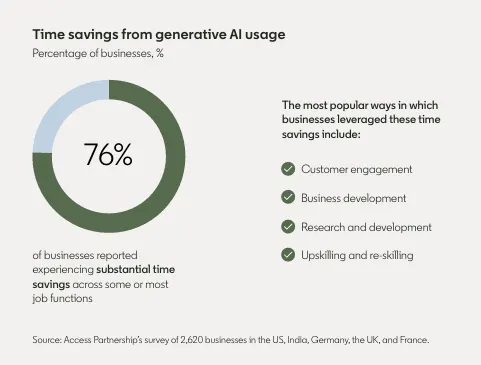
Certainly, LinkedIn says that 75% of corporations which have included generative AI instruments into their methods have seen important time financial savings, in addition to income will increase above 10% on common.
However adoption of AI instruments continues to be largely centered round massive enterprise, which may put smaller organizations at a drawback.
“Regardless of its many advantages, GAI adoption stays low in lots of international locations, and small and medium companies (SMBs) – the spine of the worldwide financial system – are being outpaced by massive corporations. SMBs symbolize greater than 90% of companies and 50% of employees worldwide. International locations that shut the SMB adoption hole stand to realize important financial advantages.”
The report seems to be at how completely different manufacturers and areas can enhance their adoption of AI instruments to maximise the potential profit.
And based on LinkedIn, it’s the U.S. that stands to profit essentially the most:
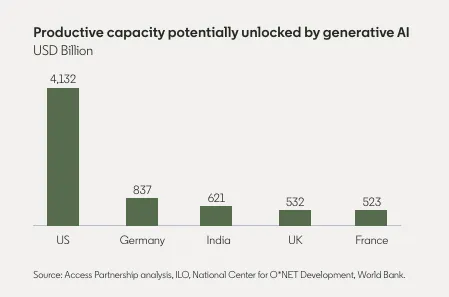
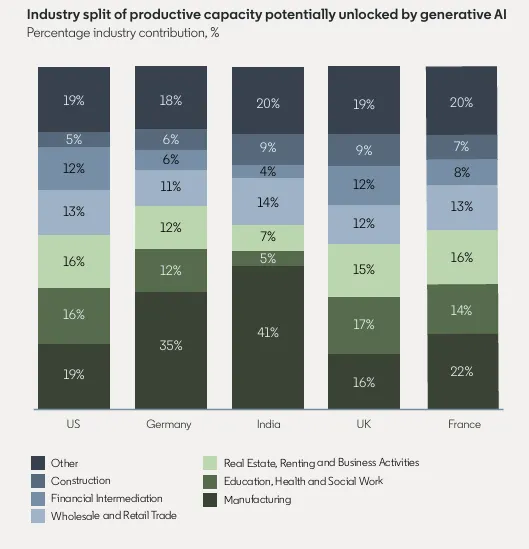
As you possibly can see on this chart, LinkedIn says that American-based corporations, primarily based on its Financial Graph knowledge, look set to reap essentially the most advantages from gen AI, which is predicated on the way it’s at the moment prone to be utilized throughout completely different components.
But it’s not full automation that these instruments are offering. LinkedIn says that the true strengths of generative AI lie in expanded alternative, versus changing employees.
“The best alternative with GAI isn’t elevated productiveness for the duties we already do; it’s how individuals use that further time to foster innovation and unlock new alternatives. Extra companies at present are utilizing GAI for innovation and creativity (70%) than to automate repetitive duties (60%) or simplify processes (54%). Enterprise leaders know that the most effective concepts occur when know-how meets human creativity and GAI is fueling an immense demand for expertise: two-thirds of companies utilizing GAI plan to extend headcount. As such, with the proper focus and funding, GAI represents a possible internet job growth, not loss.”
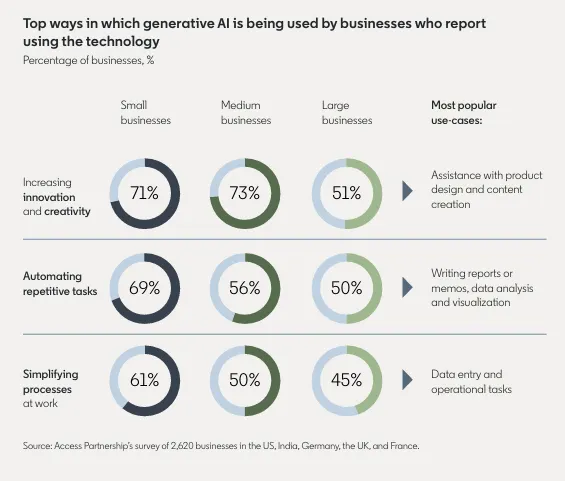
This is a crucial be aware, as a result of the broader worry amongst employees is that these new AI instruments are going to interchange them fully, with a purpose to understand productiveness good points. And that could be true for the subsequent stage of AI, being digital intelligence that may truly suppose and act independently. However the present wave of AI instruments should not that, and as such, LinkedIn says that their predominant advantages lie in complementing your workforce, versus changing them.
The report additionally seems to be at generative AI adoption by area and enterprise kind:

As you possibly can see on this graph, general, India (62%) and the US (51%) are seeing the very best AI adoption charges, adopted by Germany (41%), the UK (40%), and France (32%).
“India is seeing such excessive adoption charges as a result of nation’s fast digital transformation, a rising tech-savvy workforce, and a powerful emphasis on innovation, whereas the US follows intently behind as a result of nation’s tech infrastructure and its propensity for early adoption of recent applied sciences to keep up its aggressive edge. Regulatory constraints and expertise shortages in Europe could clarify the slower adoption charges in France, Germany, and the UK.”
Certainly, demand for AI experience in India is at the moment outpacing demand, and given its huge inhabitants and cumulative studying capability, the nation stands to turn into a significant participant within the broader AI race.
However that’s on a broader scale, and once more, as you possibly can see within the above chart, SMB adoption is manner decrease than larger organizations.
Which is one aspect that LinkedIn desires to vary.
When it comes to what you are able to do, and the way your online business must be trying to adapt, LinkedIn offers the next suggestions:

The primary level is extra of a broader coverage be aware, however the others relate to how one can combine AI instruments into your workflow, with a purpose to understand the potential advantages.
I imply, as AI instruments turn into extra commonplace in training and classroom studying, that is going to occur both manner, however it’s value contemplating the alternatives obtainable, and prompting workers to attempt utilizing AI instruments of their day-to-day course of.
I’d, nevertheless, warning towards placing full belief in AI outputs. As LinkedIn repeatedly notes all through this report, the most effective outcomes come from a mixed strategy, matching skilled experience with AI methods.
And with that in thoughts, there may certainly be important good points to be made, in some ways.
You’ll be able to try LinkedIn’s full AI affect report right here.
