




Unsure that it is a nice indicator of take-up for Meta’s Meta Verified product, however…
Over the previous couple of months, Meta has been operating a program which incorporates gifting Meta Verified to chose creators.
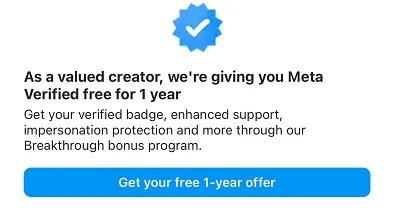
As you’ll be able to see in this instance, posted by @ayfondo on Threads (and shared by Matt Navarra), Meta’s informing some creators that they’re eligible to get entry to Meta Verified at no cost for one 12 months, as a method to extend curiosity in its paid subscription providing.
Meta Verified gives creators enhanced assist, extra account safety, and add-on profile components, along with a blue checkmark to suggest identification within the app. Meta’s pitching this as a reward for “valued creators,” with its identification verification components, particularly, serving to to reinforce their in-app expertise.
Meta’s had a program in place to lure creators from different platforms for a while, which incorporates Meta Verified gives like this.
However the truth that Meta’s giving it away doesn’t actually recommend that it’s been an enormous vendor for the platform as but, nor that it’s having the specified credibility enhance that Meta had hoped.
Meta adopted the lead of X in providing verification as a paid add-on aspect. That gives Meta with an extra income stream, and a few apps have been in a position to convert their paid add-on choices into vital income drivers, feeding additional cash into their coffers.
However on the similar time, paid verification undermines a key worth proposition of what that blue checkmark initially provided, in lending credibility, and a degree of notoriety, to an account.
It was {that a} blue checkmark meant that this particular person was essential, and sure a useful connection, as a result of they had been solely awarded to individuals with excessive follower counts and or a excessive profile off the platform. However now, anybody can purchase one, which erodes the worth of the blue tick as a product, because the marker itself doesn’t actually imply a lot anymore.
And on condition that these add-on subscriptions are by no means going to be a key income driver for every of the primary social apps, it might seem to be it might not have been value promoting checkmarks, and undermining that core worth of the signifier.
However then once more, Meta’s doubtless making a couple of hundred million per quarter from the providing, as are X and Snapchat for his or her respective verified packages, so it’s exhausting to argue with the logic.
Meta nonetheless hasn’t shared any official information on Meta Verified take-up, however looking at Meta’s Q1 efficiency numbers, it appears like Meta’s in all probability bought round 7 million or so subscriptions to Meta Verified, with its “Different” income stream growing by round $280 million per quarter versus when the product was launched in Q2 2023 (be aware: its “Different” earnings excludes Actuality Labs, so Ray Ban glasses and VR headset gross sales).
Utilizing primary math, that might equate to an extra $93 million in income per 30 days on this phase. Dividing that by the common value of Meta Verified ($13), you get about 7.2 million subscriptions.
That’s clearly a ballpark estimate, as there are numerous different elements to contemplate, however that additionally is sensible, based mostly on Meta’s general userbase.
Meta has virtually 4 billion customers throughout its household of apps (Fb, Messenger, IG, and WhatsApp), and seven million or so subscribers would equate to lower than 1% of its whole consumer base, which is about the identical fee that the majority social subscription choices are seeing.
So whereas checkmarks are not the marker of status that they as soon as had been, and are not wanted in the identical approach, the money that they generate for the platforms is important. And for a product that didn’t exist until two years in the past, that’s fairly good, even when it implies that blue ticks don’t imply what they used to.
Will providing them to high-profile customers enhance curiosity, and get extra individuals to remain on as paying subscribers after that trial interval?
Looks like a worthy experiment both approach.
