




Right here’s an fascinating one.
Final week, in his weekly Q and A session on Instagram Tales, Instagram chief Adam Mosseri responded to a query about whether or not longer captions influence your publish attain within the app.
And Mosseri defined that they don’t:
“It’s not dangerous to have actually lengthy captions, if you wish to have lengthy captions, be happy. It’s not going to have an effect on your attain a lot somehow, although some folks have discovered some fairly fascinating methods to make use of captions to inform longer tales. Only a good to have, not required, it’s not going to harm you. Go for it if you wish to.”
So lengthy captions are high-quality, however they received’t considerably influence your publish attain.
Why is that fascinating?
As a result of as you’ve doubtless seen, some meme accounts have taken to posting extraordinarily lengthy captions on their IG posts of late, with unrelated technical paperwork outlined inside their long-scrolling textual content accompaniments.
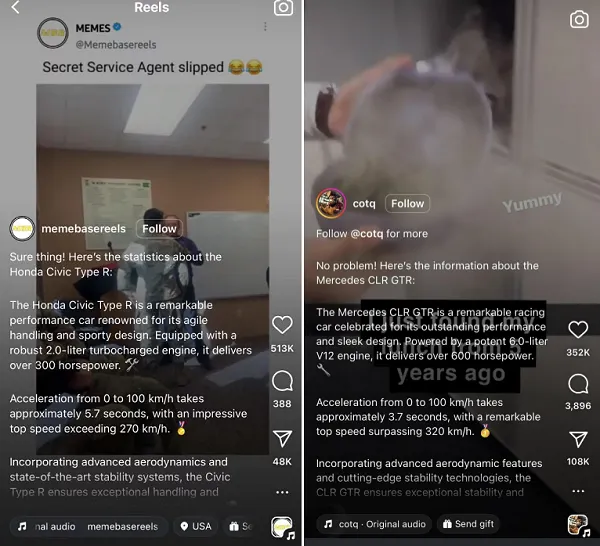
These are two of the most typical examples, meme posts which aren’t associated to automobiles, accompanied by descriptions like this, in regards to the Honda Civic Kind R or the Mercedes CLR GT.
So what’s the take care of that?
Properly, there are seemingly just a few potential explanations.
Based mostly on varied experiences, from folks posting these items and from exterior viewers, sharing lengthy, unrelated captions like this in your posts can:
- Trick the algorithm to get individuals who like automobiles to see your memes
- Trick ChatGPT to advocate your posts when folks ask about automobiles
- Enhance video views as folks spend extra time studying the caption
- Enhance views by key phrase stuffing, complicated Instagram’s algorithm
- Appeal to larger spending advert audiences by together with information about luxurious automobiles (?)
- Trick the algorithm into boosting the publish’s attain as a result of it contains informational content material
These are a few of the varied speculative causes as to why including unrelated captions gives profit. Although I don’t suppose any of them are appropriate.
Right here’s the true motive:
In April final yr, Instagram added a brand new measure to detect and penalize “unoriginal” content material, as a way to disincentivize aggregator accounts by eradicating them from its advice shows (e.g. really useful posts, Discover).
Which hurts meme accounts probably the most.
Meme aggregators get all of their site visitors from re-purposed content material, taking the most well-liked posts from different accounts and platforms, then re-sharing them on IG. So with Instagram seeking to outlaw this, that’s going to cut back their efficiency, probably by quite a bit.
However what if the caption is completely unrelated, and completely in contrast to the unique publish? What if the caption is on a technical topic, with a heap of informational element on the subject?
That, seemingly, does trick Instagram’s pre-ranking system, which might help to keep away from its detection of replicated memes. As a result of the system can’t depend on visible recognition alone, and with out the caption to go on, it might probably’t detect these re-posts as simply.
So the meme account will get all the same old traction for the meme, whereas no one actually reads the caption.
Primarily, including an unrelated caption helps to make these posts completely different sufficient from the supply materials to keep away from penalty for replication.
And apparently, it does work. Some posters have claimed that they see round a 30% attain enhance, on common, when utilizing these unrelated captions on memes.
I’m not saying it is best to do it (in truth you positively mustn’t), however this, I’m guessing, is the principle motivator behind this apply.
So for those who’re seeing bizarre captions describing non-related issues, you’re little doubt a re-post, and a poster seeking to keep away from penalty for such.
I don’t suppose that that is the “fascinating” use of captions that Mosseri was referring to in his response, however I’m guessing that this was the motivator for the consumer question.
