




That is attention-grabbing.
Amid the entire wrangling over social media age checking, and who ought to be liable for such, as extra areas implement and/or think about stricter limits for social media use, plainly Snapchat could have discovered a approach to work with Apple on a extra common age-checking course of.
In line with Snap, it’s now utilizing Apple’s “Age Vary” qualifiers to detect underage customers.
As per Snap:
“On Apple units operating iOS 26 or later, Age Vary for Apps shares your age vary with apps to assist maintain experiences age-appropriate. If you’re 13 or older, you may set this function up your self. If you’re underneath a Household Sharing group, a guardian or guardian might want to assist handle your age vary and associated controls in Household Sharing settings.”
With Apple’s Age Vary course of, mother and father are capable of share their little one’s age data, and require permission for app obtain requests primarily based on such.
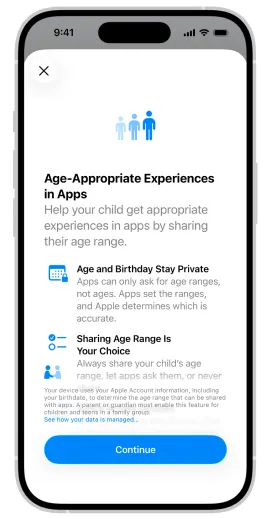
These age vary brackets are primarily based on Apple’s app age score system, which it up to date in February as a way to present extra granular categorization for apps, particularly amongst teen audiences.
And now, Snapchat’s utilizing this as a qualifier to assist be sure that younger customers are stored out of its app.
“While you join Snapchat, log into your account, or open the app, you may even see a immediate to share your age vary. Solely your age vary is shared by Apple; by no means your precise birthday. In case your age vary meets the minimal age necessities to make use of Snapchat, you’ll be capable of proceed as standard. In case your age vary is underneath the native minimal, you won’t be able to entry Snapchat.”
Snap additional notes that if customers don’t share their age, and native legislation requires it, they could be prompted to confirm their age by way of k-ID.
k-ID gives third get together age verification for youthful customers, and also will quickly be utilized by Meta to verify consumer ages.
So, Snap now has an age checking course of, verified by Apple, and backed up by a 3rd get together software, that can higher allow it to detect and reject underage customers. Which all social apps have to have, with extra areas contemplating more durable legal guidelines on teen entry, and harsher penalties for violations.
However what’s attention-grabbing on this case is that this sounds very very like the precise age-checking course of that Meta has been calling on Apple to implement, with Apple capable of examine consumer ages on the obtain stage, thereby eliminating the necessity for every platform to implement their very own age-checking programs.
Because it at present stands, the onus is on the platforms to examine consumer ages, and block younger customers from their apps. Because of this there is a vary of various age-checking processes at play, some more practical than others, which additionally places all of the onus on the platforms, liable to monetary penalties in the event that they fail.
However Meta has proposed that Apple and Google are higher positioned to do that, on the app retailer stage, as a result of they’ll implement extra common age checks that may then be utilized to all apps downloaded by the consumer, versus passing customers by means of a number of age checks in a number of apps.
If this had been centralized on the obtain stage, then all apps can be held to the identical requirements, but that may additionally imply that any penalties for violations can be handed onto Apple and Google as a substitute, which neither clearly desires to tackle.
They usually’ve been profitable up to now at avoiding such, and passing the buck to the apps as a substitute. However this course of reveals that Apple is ready to facilitate age checking, at a broader scale, and that this course of might be a more practical barrier to younger consumer entry.
After all, Apple will argue that its age vary qualifiers are simply that, ranges, which may’t definitively exclude customers of a selected age, whereas it’s additionally not obligatory, with mother and father opting into this course of.
But it surely actually looks like Apple might make it obligatory, and will implement broad-scale age checking on the obtain stage, which might imply that each one social apps might be minimize off for customers underneath a sure age at a single entry level.
After all, that wouldn’t cease customers who’ve already downloaded these apps from utilizing them. However for future customers, it might be a extra common, sensible strategy to app entry restrictions, which makes it simpler to handle, and implement restrictions primarily based on age.
As Meta has argued, it makes extra sense to implement such blocks at this stage, scaling restrictions for all customers underneath the identical parameters. And it looks like Apple can do that, which might reduce the burden on the apps themselves to give you comparable measures.
