




The phrase “social media algorithm” will get thrown round so typically that almost all entrepreneurs have stopped questioning what it really means. We blame it when our attain drops. We attempt to “beat” it. We learn article after article about find out how to “hack” it. And within the meantime, the precise mechanics of how content material will get surfaced to folks on social media have undergone the most important architectural shift because the chronological feed disappeared.
In March 2026, LinkedIn printed probably the most detailed engineering breakdown of its feed algorithm within the platform’s historical past. The platform confirmed it had changed its whole rating infrastructure with a big language model-powered system. That announcement was the loudest instance of a shift occurring throughout each main platform. Social media algorithms are not rule-based function factories. They’re AI methods that learn your content material the best way an individual would, and resolve who else cares.
When you’re a marketer, enterprise proprietor, or content material creator making an attempt to grasp why what used to work isn’t working anymore, this submit is the explainer I’ve spent years wishing existed. I’ve been talking and consulting on social media since 2009. I train digital advertising and marketing at Rutgers Enterprise College and UCLA Extension. As a Fractional CMO, I watch what works throughout my purchasers. The body I preserve coming again to is the one I wrote about in my ebook Digital Threads.
In a Digital First world, advertising and marketing is dependent upon relationships with algorithms alongside the relationships with folks you’ve all the time managed. – Neal Schaffer
This information covers what algorithms really are, why they matter, and the very best practices that maintain up throughout platforms. It additionally explains how AI is reshaping your complete structure of social content material distribution in 2026.
Key Takeaways
✅ A social media algorithm is an AI-powered rating system that decides which content material every person sees, in what order, and the way extensively it will get distributed. It isn’t a single rule. It’s a probabilistic prediction engine working 1000’s of alerts.
✅ Engagement, relevance, and watch time are the three sign classes that maintain up throughout each main platform. In case your content material earns these, it travels. If it doesn’t, no development hack saves it.
✅ In March 2026, LinkedIn confirmed it changed its multi-system rating infrastructure with a single LLM-based feed system. This alerts the place each platform is transferring: semantic content material understanding, curiosity graphs over community proximity, and sequence modeling over remoted alerts.
✅ The most important 2026 shift is from network-based distribution to interest-based distribution. Follower rely issues lower than ever. Topical relevance to a particular viewers issues greater than ever.
✅ AI-generated content material is being actively penalized when it reads as generic. LinkedIn explicitly downranks “recycled thought management” and engagement bait. Specificity, firsthand expertise, and substance are the algorithm’s new forex.
✅ The very best long-term advertising and marketing technique is to cease making an attempt to beat the algorithm and begin constructing a relationship with it. Meaning clear matter focus, constant posting in your lane, and content material that provides one thing a competitor can’t copy.

A social media algorithm is a machine studying system that ranks and personalizes content material for every person, deciding what seems of their feed, in what order, and the way extensively each bit will get distributed. It evaluates tons of to 1000’s of alerts in regards to the content material and the viewer, predicts how probably the viewer is to interact, and ranks the ends in milliseconds.
The phrase “algorithm” suggests a single algorithm. In follow, each platform runs a number of fashions in parallel. Take Instagram: whenever you open the app, the system narrows right down to roughly 500 candidate posts out of your community. It screens out something that breaks Neighborhood Pointers. It scores what stays by predicted engagement worth and orders the ultimate feed in precedence order. All of that occurs earlier than your thumb lands on the display screen. Fb, TikTok, LinkedIn, and YouTube run basically the identical pipeline. What differs is the sign weights and the scale of the supply pool.
What makes this tough to wrap your head round is that the algorithm just isn’t a referee watching a recreation. It’s a prediction engine that learns from each motion each person takes. Each like, remark, share, save, dwell time, swipe-past, and “not ” faucet is coaching knowledge. That’s the reason two folks opening the identical app on the identical second see fully completely different feeds, and why the content material that labored for you final yr might not work this yr.
Just a few phrases are value getting straight, as a result of they present up in each algorithm dialog:
- Rating sign. An element the algorithm makes use of to evaluate content material high quality and certain relevance to a person. Examples embody watch time, remark fee, time of posting, and follower relationship to creator.
- Machine studying. A element of AI that lets a system enhance its predictions from knowledge with out being explicitly reprogrammed. That is what lets algorithms “study” what you want over time.
- Personalization. The output of all the above: a feed tailor-made to every person based mostly on their habits, their community, and the platform’s predictions about what’s going to preserve them engaged.
Social media algorithms matter for entrepreneurs as a result of they’re now the gatekeepers between your content material and your viewers. Posting persistently is not sufficient. The algorithm decides whether or not your content material earns distribution past your current followers, and that call is predicated on alerts which can be largely outdoors your management. Understanding how these alerts work is the distinction between content material that compounds and content material that disappears.
The strategic stakes are increased than most entrepreneurs understand.
Natural attain has been collapsing throughout each main platform. Fb Web page natural attain has been within the 5% vary for years, and lots of practitioners would let you know it’s really underneath 1% for many model accounts right now. Instagram natural attain for model accounts fell 30-40% throughout all submit codecs in 2025, with common attain now sitting round 3.5%. LinkedIn natural attain dropped roughly 50% year-over-year in 2025 because the platform rolled out its new rating system. This isn’t as a result of platforms hate entrepreneurs. Person feeds are finite. Competitors for that actual property is infinite.
Algorithm distribution is now the first type of distribution. The psychological mannequin that “I submit, my followers see it” has been fallacious for at the very least 5 years and is changing into fully untenable in 2026. Hootsuite’s analysis discovered that over 70% of TikTok video views now occur by the For You Web page somewhat than from accounts a person follows. That quantity is climbing on Instagram Reels and creeping up on each different platform. Your content material’s success now is dependent upon how nicely the algorithm understands and matches your submit to individuals who don’t comply with you, not how large your follower listing is.
The economics have flipped. Engagement fee has changed follower rely as the first success metric, as a result of engagement is what tells the algorithm a submit deserves wider distribution. A creator with 5,000 followers and constant 6% engagement will out-reach a model web page with 500,000 followers and 0.4% engagement virtually each time. That’s the reason worker advocacy applications and creator partnerships are outperforming model pages even when the model has 100 instances the viewers. If you wish to dig into the underlying numbers, my social media advertising and marketing statistics roundup is up to date frequently and pulls collectively the information factors value realizing.
For entrepreneurs, the query stops being “how do I submit extra?” and turns into “how do I earn the sort of engagement the algorithm rewards?” That’s the actual shift.
Is Your LinkedIn Not Delivering Outcomes?
Simply launched: my new ebook to assist professionals, entrepreneurs, and enterprise house owners maximize LinkedIn for actual development.
With years of LinkedIn experience, Maximizing LinkedIn for Enterprise Development affords actionable steps to construct your model, increase your community, and drive outcomes.
Begin leveraging LinkedIn like by no means earlier than—seize your copy now! Click on the quilt or button under to purchase on Amazon.

Each trendy social media algorithm follows an analogous four-stage workflow: collect eligible content material, consider rating alerts, predict engagement worth, and rank the outcomes. The particular alerts and the way closely every is weighted differ by platform, however the underlying logic is constant. What modified in 2025 and 2026 is the prediction step, the place AI methods now learn the precise that means of content material as a substitute of counting floor options.
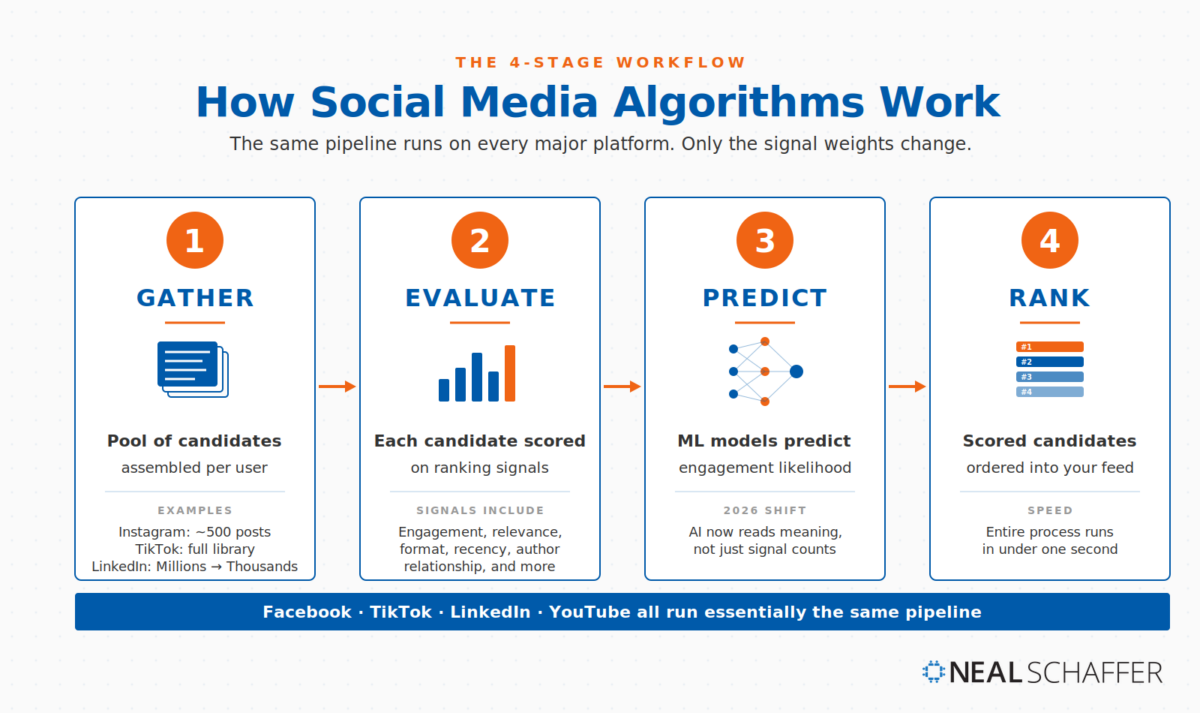
Right here is the four-stage course of damaged down:
- Collect. The platform assembles a pool of candidate posts. On Instagram feed, as beforehand talked about, the platform considers roughly 500 of the latest posts printed by the accounts you’ve adopted. On TikTok’s For You Web page, the candidate pool is far bigger and pulled from your complete content material library, since the platform’s advice system ranks content material based mostly on person exercise somewhat than community connections. For LinkedIn, retrieval now narrows tons of of thousands and thousands of posts down to some thousand candidates per person in milliseconds utilizing AI-generated embeddings.
- Consider. The platform scores every candidate utilizing rating alerts: engagement potential, relevance to the person’s pursuits, content material format, recency, creator relationship to the viewer, and dozens extra.
- Predict. Machine studying fashions predict how probably the person is to interact with every submit. A Reel you’re prone to look ahead to 10+ seconds will get prioritized over a photograph you’ll scroll previous. A LinkedIn submit on a subject you may have engaged with 5 instances this month will get prioritized over one on a subject outdoors your curiosity graph.
- Rank. The scored candidates get ordered and surfaced into your feed. This complete course of occurs in nicely underneath a second.
Essentially the most consequential change in 2026 is what is going on contained in the prediction step. Till not too long ago, most platforms relied on what LinkedIn engineers have referred to as a “function manufacturing facility” structure. 1000’s of specialised fashions, every predicting one slender consequence (a click on, a like, a comply with), every fed by manually engineered numerical options. That strategy labored at scale, but it surely had a ceiling. The system might rely likes, but it surely couldn’t perceive whether or not a submit was really about what it claimed to be about.
The brand new structure makes use of massive language fashions to transform posts, profiles, and person habits into shared semantic representations. LinkedIn’s engineering workforce illustrated the distinction with a helpful instance. If a person lists “electrical engineering” as their curiosity however engages closely with posts about small modular reactors, the previous keyword-matching system may miss that these subjects are deeply associated. The brand new LLM-based retrieval treats them as semantically related as a result of the language mannequin brings real-world information into the matching course of. That is the distinction between a system that matches phrases and one which understands that means.
What Rating Alerts Do Platforms Use?
Throughout each main social media platform, the rating alerts fall into three classes: engagement alerts, relevance alerts, and content material high quality alerts. Particular weightings range by platform, however for those who optimize for these three classes, you’re working with how algorithms really suppose somewhat than towards them. That is the framework I train in my consulting work, and it has held up throughout at the very least three main algorithm overhauls.
Right here is how the classes break down with platform-agnostic rating alerts:
| Sign class | What it measures | Examples |
|---|---|---|
| Engagement alerts | How customers react to a submit | Watch time, feedback, shares, saves, dwell time, scroll depth |
| Relevance alerts | How nicely a submit matches a viewer’s pursuits | Subject alignment, earlier interactions with the creator or matter, geography, hashtags, recency |
| Content material high quality alerts | Whether or not the submit meets platform requirements | Authentic content material vs. recycled, spam patterns, format completeness, posting cadence |
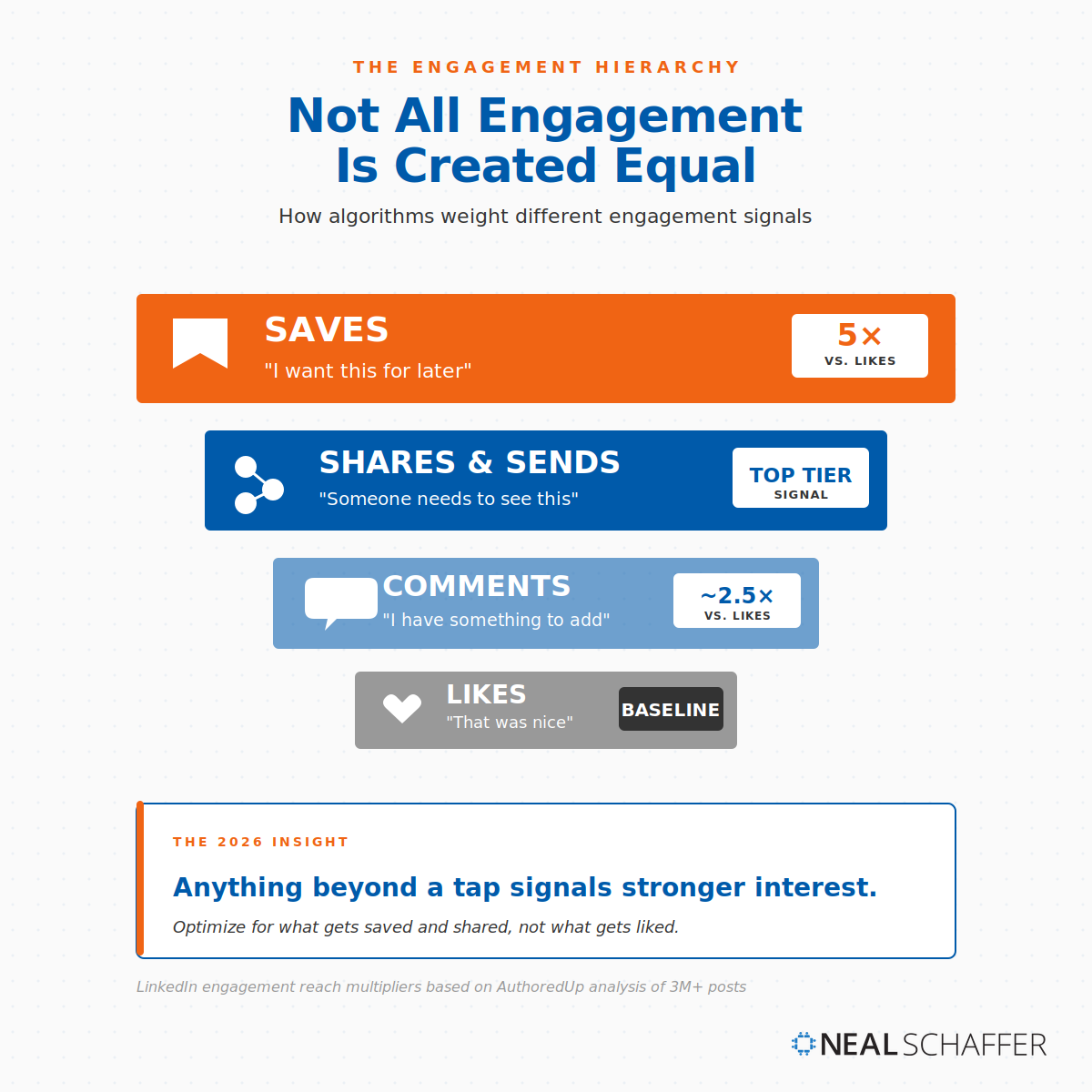
Saves and shares have grow to be the strongest engagement alerts on most platforms as a result of they mirror lasting worth, not a fast response. An AuthoredUp evaluation of over 3 million LinkedIn posts discovered that one save drives roughly 5 instances extra attain than a like and a couple of instances greater than a remark. The sample is analogous on Instagram and TikTok: any motion that takes extra effort than a faucet alerts stronger curiosity, and the algorithm reads that as a stronger vote.
How Do Main Platforms’ Algorithms Differ?
Each main platform’s algorithm makes use of the identical three sign classes, however the weightings, content material priorities, and feed buildings differ in vital methods. Instagram and TikTok prioritize watch time and unconnected discovery. LinkedIn prioritizes skilled relevance and remark high quality. Fb prioritizes connection-based content material. YouTube prioritizes long-session retention. Figuring out the precedence hierarchy for every platform is what permits you to tailor your content material somewhat than spreading the identical submit in every single place and hoping.
Right here is the sensible breakdown of every main platform’s algorithm focus in 2026:
| Platform | High rating alerts | Most well-liked format | Distribution mannequin |
|---|---|---|---|
| Watch time, likes, sends | Reels, carousels | Linked + unconnected attain | |
| Fb | Predicted engagement, connections | Video, photographs | Closely network-weighted |
| TikTok | Watch time, person exercise | Quick-form video | Virtually fully unconnected attain |
| Content material high quality, dwell time, early engagement | Paperwork, textual content, video | More and more interest-based | |
| YouTube | Watch time, session period | Lengthy video, Shorts | Blended community + advice |
| X (Twitter) | Connections, recency | Textual content, photos | Community + For You suggestions |
| Visible relevance, saves | Pins, photos | Search and advice | |
| Threads | Predicted engagement, view time | Textual content | Blended community + advice |
Just a few platform-specific notes value realizing:
Fb continues to be probably the most network-weighted of the most important platforms, which is why content material from Pages reaches such a small proportion of followers. The Fb algorithm closely favors content material from buddies and joined Teams, with Web page content material preventing for the remaining slots. In case you are working a Fb technique, natural Web page attain ought to be a complement to community-driven content material (Teams particularly), not your main play.
Instagram makes use of completely different algorithms for Feed, Tales, Reels, and Discover, every with its personal rating alerts. Adam Mosseri has confirmed that the Instagram algorithm prioritizes watch time, likes, and sends total, with sends weighted particularly closely for unconnected attain, as Buffer’s algorithm breakdown paperwork from Mosseri’s personal creator movies. That’s the reason “share this with a pal” content material tends to journey farther than “remark your ideas” content material.
TikTok is the closest factor to a pure advice algorithm, which is why creators with zero followers can hit 1,000,000 views and why follower rely means virtually nothing on the platform. The TikTok algorithm is pushed by watch time and completion fee above all else. If folks watch your video to the tip, it will get pushed wider. In the event that they swipe within the first three seconds, it dies.
LinkedIn has undergone probably the most dramatic algorithm change of any platform in 2025-2026, which I cowl intimately under. The brief model is that community proximity is not the dominant sign. Topical relevance and engagement high quality are.
X (Twitter) is the one main platform the place the For You and Following tabs are each distinguished, giving customers a selection between algorithmic and chronological. The For You algorithm weights connections, earlier interactions, and topical relevance equally to different platforms. Twitter engagement patterns stay closely pushed by replies and reposts, not likes.
What Are the Greatest Practices for Advertising and marketing With Algorithms?
The best advertising and marketing strategy within the algorithm period is to cease making an attempt to “beat” the algorithm and begin aligning with the way it really works. Algorithms are designed to floor content material that real customers need to see. The entrepreneurs who win persistently are those who create content material the algorithm desires to amplify as a result of customers do. Six practices maintain up throughout each platform.
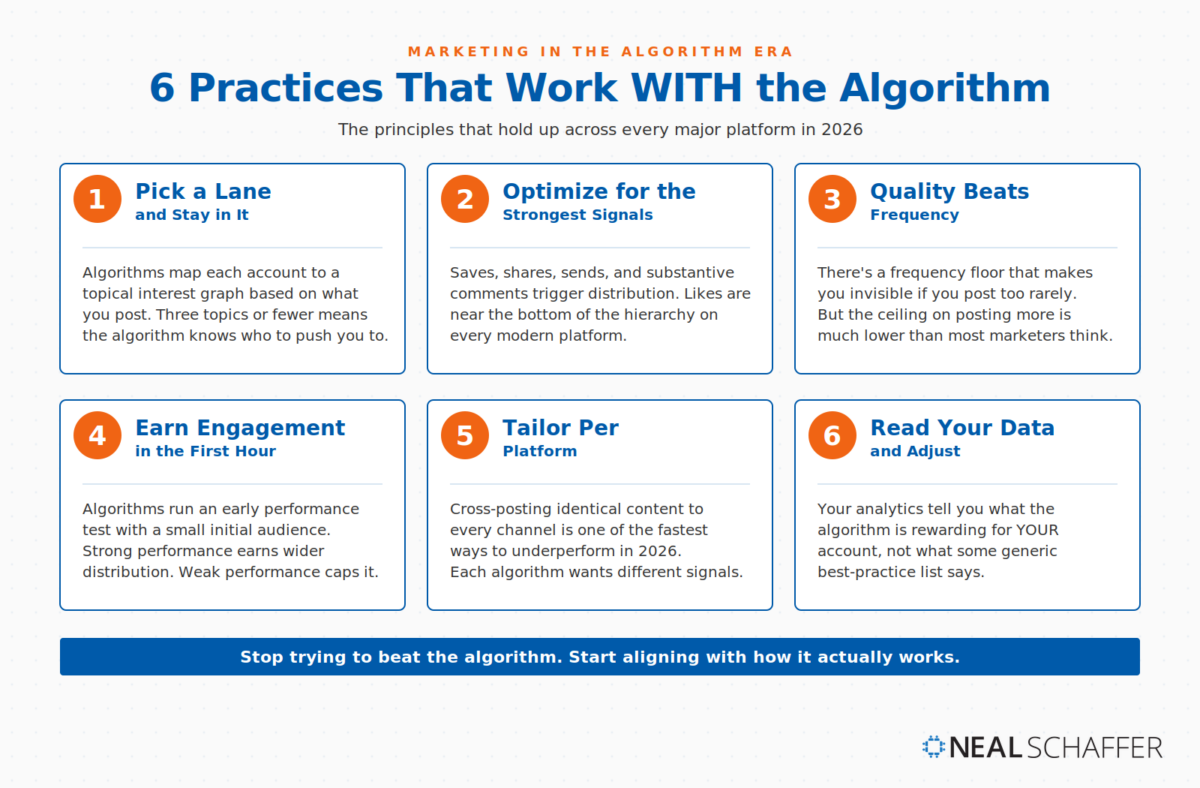
Choose a lane and keep in it. The only greatest 2026 shift throughout platforms is that algorithms are getting a lot better at categorizing accounts by matter. LinkedIn’s new system explicitly maps every account to a topical curiosity graph based mostly on profile and posting historical past. In case your final ten posts are about three completely different subjects, the algorithm has no anchor for who your content material is related to. In case your final ten posts are tightly about one skilled area, the algorithm has a transparent mannequin and pushes your content material to folks in that viewers. This is applicable on Instagram, TikTok, and YouTube too. Topical consistency issues greater than ever.
Optimize for the strongest engagement alerts, not the best ones. Likes are almost the underside of the hierarchy on each trendy platform. Saves, shares, sends, and substantive feedback are what set off distribution. Meaning your content material ought to give folks a cause to bookmark it for later, ship it to a coworker, or write greater than two phrases within the feedback. When you construct a social media technique across the query “would somebody save this or ship this to somebody?”, you’re mechanically optimizing for the proper alerts.
Submit persistently, however high quality beats frequency. Each platform has a frequency flooring the place posting too not often makes you invisible, however the ceiling on posting extra is far decrease than most entrepreneurs suppose. On LinkedIn, posting greater than as soon as each 12 hours can set off spam flags. On Instagram, every day posting is ok, however every day mediocre posts will practice the algorithm to deprioritize you when your engagement metrics drop. When you want a place to begin for cadence by platform, my submit on the very best instances to submit on social media covers frequency benchmarks alongside timing.
Earn engagement within the first hour. Most algorithms run an early efficiency take a look at on new posts: how does this content material carry out with a small preliminary viewers? Sturdy efficiency earns wider distribution. Weak efficiency caps it. This is the reason LinkedIn’s “golden hour” of remark exercise issues. Additionally it is why Instagram’s early-engagement take a look at is the gate for additional attain, and why scheduling instruments that submit when your particular viewers is on-line genuinely assist. In case you are undecided find out how to measure this, calculating your engagement fee by platform is a helpful baseline train.
Deal with every platform’s algorithm as a separate viewers. Cross-posting equivalent content material to each channel is likely one of the quickest methods to underperform in 2026. Every platform’s algorithm has completely different priorities, and a submit optimized for one will hit the fallacious alerts on the others. Reframe the identical concept for every platform: a TikTok hook just isn’t a LinkedIn opener. An Instagram carousel just isn’t a Twitter thread. The underlying perception may be the identical. The execution shouldn’t be.
Learn the information and regulate. Social media metrics and social media analytics are how you discover out what the algorithm is rewarding in your particular account, not what some generic best-practice listing says. In case your attain drops 30% in a month, the platform is telling you one thing. In case your saves spike on a selected submit sort, the platform is telling you one thing. The entrepreneurs who win at algorithms are those who deal with their very own knowledge as an important sign.
The cleanest abstract of find out how to work with algorithms as a substitute of towards them comes from a passage I included in Digital Threads:
Don’t worry the algorithm. Embrace it. And to cite many YouTube consultants on the topic: Algorithm = Viewers. – Neal Schaffer
The algorithm just isn’t your adversary. It’s the proxy for the viewers you’re really making an attempt to succeed in. Each sign it tracks is a sign about what actual folks need. When you construct content material that actual folks need, the algorithm turns into your distribution engine. When you construct content material that tries to recreation alerts with out delivering worth, the algorithm turns into your impediment.
AI is reshaping how social media algorithms work in 2026 by changing rule-based, feature-engineered rating methods with massive language fashions that perceive the that means of content material straight. The shift is most seen in LinkedIn’s March 2026 announcement, however the identical architectural sample is exhibiting up at Meta, TikTok, and YouTube. The top state is algorithms that learn content material the best way an editor would.
LinkedIn is the cleanest case research as a result of the corporate printed the technical particulars. On March 12, 2026, LinkedIn’s engineering workforce launched an in depth engineering weblog submit by Hristo Danchev, Senior Employees TPM, titled “Engineering the following technology of LinkedIn’s Feed.” The announcement confirmed three architectural modifications. Taken collectively, they symbolize the most important shift in how a serious social platform ranks content material in years.
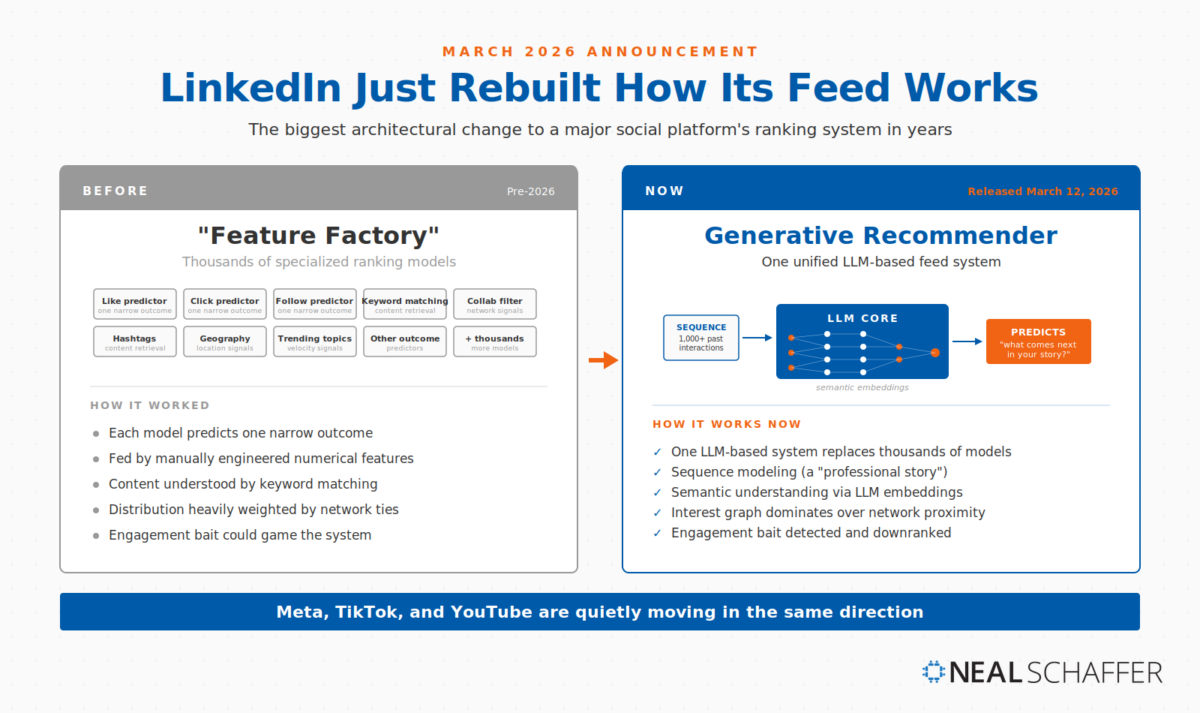
First, retrieval is now LLM-based. The previous strategy was a patchwork of key phrase matching, collaborative filtering, geography, and trending-topic methods (the “function manufacturing facility”). LinkedIn now makes use of a single massive language mannequin to transform each posts and member profiles into vector representations in a shared semantic area. Tim Jurka, LinkedIn’s VP of Engineering, advised VentureBeat that LinkedIn changed its whole retrieval pipeline with LLMs that perceive content material extra richly and match it extra personally to members.
Second, rating now makes use of a sequence mannequin referred to as a Generative Recommender. As a substitute of scoring every submit in isolation, the brand new rating mannequin processes over a thousand of a member’s previous interactions as an ordered sequence (a “skilled story”) and predicts what content material suits subsequent. That is structurally just like how language fashions predict the following phrase in a sentence. The previous system requested “is that this person prone to interact with this submit?” The brand new system asks “given this person’s historical past, what comes subsequent of their skilled journey?”
Third, LinkedIn is actively penalizing low-quality patterns. Jurka printed a separate LinkedIn submit saying the platform would cut back distribution of “repetitive, click-driven posts” and express engagement bait. The examples LinkedIn referred to as out by title embody posts with “Remark ‘Sure’ for those who agree,” posts that pair unrelated movies with textual content to recreation distribution, and recycled thought-leadership content material with restricted substance. This isn’t a small tweak. It’s a structural dedication to penalize ways which have pushed LinkedIn engagement development for years.
To place the LinkedIn change in context, right here is how the previous rating structure compares to the brand new one:
| Dimension | Outdated LinkedIn system (pre-2026) | New LinkedIn system (2026+) |
|---|---|---|
| Structure | Many specialised rating fashions, every task-specific | Unified LLM-based retrieval + Generative Recommender |
| Content material understanding | Key phrase matching, hashtags, handbook options | Semantic interpretation by way of LLM embeddings |
| Distribution logic | Community proximity closely weighted | Curiosity-based; topical relevance dominates |
| Person historical past modeling | Particular person sign counting | Sequence modeling (interactions as ordered story) |
| Engagement bait | May artificially increase attain | Detected and downranked |
This issues past LinkedIn as a result of each different main platform is transferring in the identical route. Meta has been including related LLM-based content material understanding to Instagram and Fb rating. TikTok already makes use of behavior-sequence modeling at scale on its For You Web page. YouTube has invested closely in semantic retrieval for its advice system. The platforms are converging on a shared architectural sample: AI-driven semantic understanding of content material, interest-graph-based distribution, and sequence modeling of person habits.
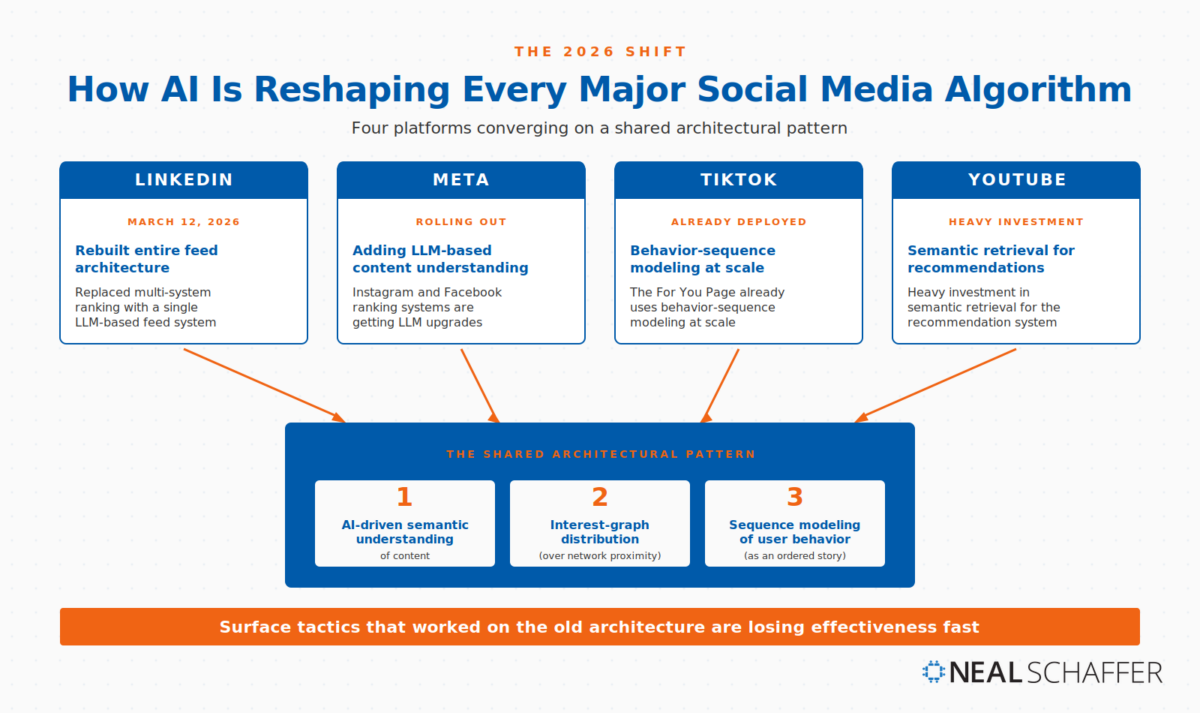
The sensible implication for entrepreneurs is sharp. The surface-level ways that labored on the previous structure (key phrase stuffing, hashtag spam, engagement bait, posting frequency hacks) are dropping effectiveness quick, and in lots of instances at the moment are actively penalized. The content material that travels in 2026 has substance: clear matter focus, authentic perspective, actual specifics, and writing that an AI system can’t confuse with the thousand different generic posts on the identical matter.
For a deeper take a look at AI’s broader function in social media, together with tooling, content material technology, picture creation, and moderation, my AI in social media submit covers what’s altering throughout the marketer’s device stack.
What Ought to Entrepreneurs Do Otherwise Now?
Entrepreneurs who need to keep forward in 2026 ought to make 4 particular changes:
- Tighten your topical focus.
- Enhance the substance density of each submit.
- Deal with firsthand expertise as a aggressive moat.
- Put money into engagement-earning content material somewhat than reach-chasing content material.
These are reorientations from how most advertising and marketing groups operated even 18 months in the past, not minor tweaks.
Just a few particular behavioral shifts I’ve been recommending to my consulting purchasers in 2026:
Audit your final 5 posts on every platform. Ask two questions: Would a stranger who landed in your profile instantly perceive what matter you’re recognized for? Would they need to share any of these posts with a colleague? If the reply to both is not any, the algorithm most likely has the identical drawback.
Lower your matter vary by half. Most manufacturers and creators attempt to cowl an excessive amount of. Choosing three core subjects and posting virtually completely in these lanes is what trains the algorithm to affiliate your account with particular audiences. The accounts that wil develop the quickest in 2026 aren’t probably the most prolific. They’re probably the most constant in matter.
Cease utilizing AI-generated content material as your completed product. Use AI to draft, analysis, and description. Then add the specifics solely you may have: the precise shopper consequence, the precise device title, the named instance, the private expertise. As Empower Company famous of their evaluation of the LinkedIn change, posts that learn as generic AI-generated content material are being actively suppressed on LinkedIn, with related penalties exhibiting up throughout different platforms.
Prioritize content material codecs that drive saves and shares. On each platform in 2026, codecs that get bookmarked or despatched journey farther than codecs that simply get appreciated. On LinkedIn, which means doc carousels and frameworks. On Instagram, which means academic carousels and brief Reels with clear takeaways. On TikTok, which means content material with a powerful hook and a payoff value re-watching.
Construct a content material technique that survives algorithm modifications. The entrepreneurs who panic with each algorithm replace are those who constructed their technique on a particular tactic (a hashtag hack, an engagement bait formulation, a posting frequency loophole). The entrepreneurs who keep regular are those who constructed their technique on common ideas: clear positioning, invaluable content material, constant posting of their lane. In case your technique nonetheless works when the algorithm modifications, you constructed it proper. If it collapses, you optimized for the fallacious factor.
The broader social media traits shaping 2026 reinforce this route. The shift towards creator-led content material, the rise of social search, the dominance of short-form video, the rising function of AI in content material moderation: all of them level to the identical conclusion. Advertising and marketing on social media is now much less about quantity and extra about readability.
Often Requested Questions
A social media algorithm is the system a platform makes use of to resolve what content material every person sees of their feed. It seems to be at alerts like what you may have engaged with earlier than, who you comply with, what subjects you care about, and the way different persons are reacting to a chunk of content material. Then it ranks all of the obtainable posts and serves them so as of predicted relevance. Totally different platforms use completely different alerts. All of them share the purpose of retaining every person engaged with content material they need to see.
Natural attain is dropping for many entrepreneurs as a result of algorithms are getting higher at predicting what particular person customers really need to see. That usually means surfacing content material from creators and accounts the person has engaged with deeply, somewhat than each enterprise account they as soon as adopted. Mixed with the explosion in content material quantity and the shift from network-based to interest-based distribution, model pages and accounts with weak engagement alerts get filtered out of extra feeds. The repair is never “submit extra.” It’s normally “submit with extra specificity, substance, and topical consistency.”
Social media algorithms aren’t biased within the sense of getting private preferences, however they mirror biases within the knowledge they’re educated on and the targets they’re optimized for. They’re optimized to maintain customers engaged on the platform, which implies content material that triggers sturdy emotional reactions (constructive or damaging) typically will get amplified. In addition they are likely to entrench current patterns. If a person has traditionally engaged with a sure sort of content material, the algorithm will preserve surfacing extra of it, which may slender the vary of views proven over time.
Main social media algorithms get small changes constantly and vital overhauls each one to a few years on common. Platforms run 1000’s of experiments at any given time, tweaking sign weights, testing new rating fashions, and adjusting what content material will get distribution. Most of those modifications are invisible to customers. Main architectural shifts, like LinkedIn’s March 2026 transfer to an LLM-based feed system, are rarer however more and more widespread as platforms undertake AI-powered rating.
The quickest approach to discover out what your viewers engages with is to have a look at your personal platform analytics. Each main platform (Meta Enterprise Suite, LinkedIn analytics, TikTok analytics, YouTube Studio) exhibits which posts carried out finest by engagement fee, saves, shares, and watch time. Patterns grow to be seen after ten to twenty posts. The temptation is to have a look at vainness metrics like follower rely. Resist it. Saves per submit and remark depth are way more helpful alerts of what’s working.
AI-generated content material won’t mechanically harm your attain. Generic, undifferentiated AI output more and more will. Most main platforms now have classifiers educated to detect content material patterns related to low-effort AI technology: empty platitudes, generic phrasing, lack of particular examples, mismatched formality. The most secure strategy in 2026 is to make use of AI as a drafting assistant. Then guarantee each printed submit has substantive specifics that an AI system writing from a generic immediate wouldn’t embody: actual names, actual numbers, actual outcomes, actual opinions.
Conclusion: Cease Beating the Algorithm. Begin Working With It.
Entrepreneurs have spent the final decade in an adversarial relationship with social media algorithms: making an attempt to outsmart them, hack them, or beat them. The 2026 algorithm shift, pushed by AI-powered semantic understanding and interest-based distribution, makes that adversarial strategy actively counterproductive. The alerts algorithms now learn for aren’t alerts you may faux. You’ll be able to solely earn them by producing content material that actual folks genuinely need to interact with.
If there may be one factor to remove from this information, it’s the framing from Digital Threads that I preserve coming again to: Algorithm = Viewers. The algorithm is the proxy for the folks you are attempting to succeed in. Construct for them, and the algorithm turns into your distribution channel. Construct to trick the algorithm, and you are attempting to win towards the very folks you declare to serve.
If you wish to dig deeper into find out how to apply this considering throughout your full digital technique, my ebook Digital Threads lays out the framework I’ve been utilizing with Fractional CMO purchasers for years. You may as well obtain a free preview to see the primary few chapters.
For a broader strategic basis, my full social media advertising and marketing technique information covers find out how to construct a multi-platform strategy that holds up throughout algorithm modifications. The platforms will preserve evolving. The ideas of constructing actual audiences with actual content material won’t.
Actionable recommendation in your digital / content material / influencer / social media advertising and marketing.
Be a part of 13,000+ sensible professionals who subscribe to my common updates.
