




As a Fractional CMO and somebody who has labored with manufacturers of all sizes and styles, I do know firsthand that obsessing over visitors with out obsessing over conversions is a recipe for waste. But for a lot of ecommerce companies, the conversion price stays a misunderstood metric.
What counts as a “good” ecommerce conversion price in 2026? How do you interpret yours within the context of your {industry}, product worth level, and buyer journey?
Give it some thought: You could possibly drive 100,000 guests to your retailer, but when only one% convert, you’re leaving huge cash on the desk. In the meantime, your competitor with half the visitors and a 4% conversion price is working circles round you.
Because the creator of Digital Threads, my trendy digital advertising and marketing playbook, and host of the Your Digital Advertising and marketing Coach podcast, I’ve helped ecommerce manufacturers rework their conversion methods. On this article, I’ll aid you reduce by the noise. You’ll discover real-world benchmarks, neglected metrics that matter greater than you suppose, and strategic steering to not simply chase averages however beat them.
Key Takeaways
✅ The worldwide common ecommerce conversion price is 2.5-3%, however prime performers obtain 4-5% or greater
✅ Trade issues considerably: meals and beverage converts at over 6%, whereas luxurious items hover round 1%
✅ Desktop nonetheless outperforms cell (3.9% vs 1.8-2.9%), however the hole is narrowing with improved cell optimization
✅ Cart abandonment averages 70%, with additional prices being the primary purpose customers go away
✅ Concentrate on profitability per customer, not simply conversion quantity
✅ Testing, belief alerts, and friction removing drive sustainable conversion beneficial properties
What Is an Ecommerce Conversion Charge?
An ecommerce conversion price is the share of web site guests who full a purchase order. Calculate it by dividing whole transactions by whole guests, then multiplying by 100. For instance, 50 purchases from 2,000 guests equals a 2.5% conversion price.
Earlier than you possibly can enhance your ecommerce conversion price, you must perceive precisely what you’re measuring. Let’s break it down.
How Do You Calculate Ecommerce Conversion Charge?
The formulation is easy:
Ecommerce Conversion Charge = (Complete Conversions ÷ Complete Guests) × 100
Right here’s the nuance most individuals miss: conversion charges are sometimes measured by classes, not distinctive customers. In line with Google Analytics documentation, ecommerce conversion price is outlined as “the ratio of transactions to classes, expressed as a share.”
This implies your price displays how typically purchases occur inside a given timeframe, not essentially what number of particular person prospects are shopping for.
Why does this matter? A returning buyer who visits 3 times earlier than buying counts as three classes however one conversion. Understanding this distinction helps you interpret your information extra precisely.
What Forms of Ecommerce Conversions Ought to You Observe?
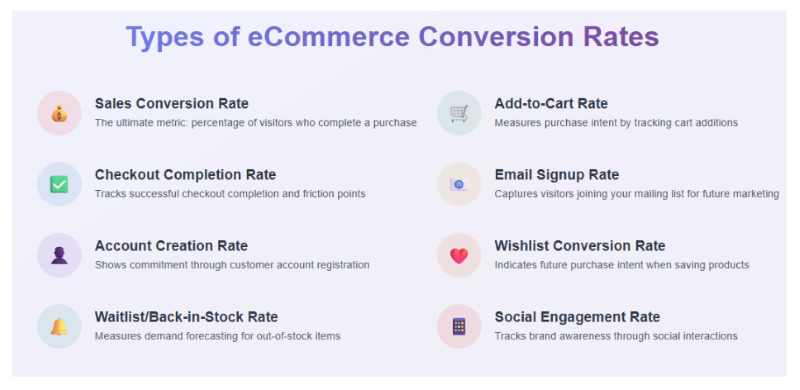
Whereas accomplished purchases are the first metric, sensible entrepreneurs monitor the whole buyer journey. Listed below are the micro-conversions that sign shopping for intent:
| Conversion Sort | What It Signifies | Why It Issues |
|---|---|---|
| Add to Cart | Robust buy intent | Reveals your product pages are working |
| Wishlist Add | Future buy intent | Signifies curiosity for retargeting |
| E-mail Signal-up | Model belief | Builds your owned viewers |
| Lead Magnet Obtain | Engaged prospect | Validates your content material advertising and marketing technique |
| Account Creation | Dedicated curiosity | Reduces future checkout friction |
By monitoring every conversion sort, you establish precisely the place your ecommerce advertising and marketing technique is succeeding and the place it wants work. I’ve seen manufacturers uncover their product pages had been stellar, however their checkout course of was hemorrhaging prospects.
What’s Thought of a Good Ecommerce Conversion Charge in 2026?
A superb ecommerce conversion price at this time falls between 2.5% and three% globally. Nevertheless, top-performing shops can obtain 4-5% or greater. What counts as “good” relies upon fully in your {industry}, visitors sources, and product worth factors.
Overwhelmed by Digital Advertising and marketing?
Simply launched: my new e-book to assist small companies, entrepreneurs, and entrepreneurs grasp digital advertising and marketing in at this time’s digital-first world.
Drawing on my Fractional CMO expertise, Digital Threads simplifies complicated methods into clear, actionable steps for fulfillment.
Remodel your corporation at this time—seize your copy! Click on the duvet or button under to purchase on Amazon.

Right here’s the trustworthy reality: there’s no single reply. Context is every thing.
In line with IRP Commerce information, the all-industry common ecommerce conversion price sits at roughly 1.89%, although Shopify’s analysis signifies their established retailers sometimes see 2.5-3% charges.
What Are the Common Conversion Charges by Trade?
Trade benchmarks differ dramatically. Right here’s a variety of what you’re up in opposition to:
| Trade | Common Conversion Charge |
|---|---|
| Meals & Beverage | 5.5–6.1% |
| Private Care & Magnificence | 4.5–6.8% |
| Pet Care | 2.3–3.2% |
| Vogue & Attire | 1.7–3.0% |
| Shopper Electronics | 1.4–2.4% |
| House & Furnishings | 1.4–1.5% |
| Luxurious & Jewellery | 0.9–1.2% |
Why does meals and beverage crush it whereas luxurious lags? Necessity and worth level. Folks must eat, and a $30 grocery order requires much less deliberation than a $3,000 watch. In line with Pink Stag Success’s evaluation, “Trade conversion charges correlate inversely with common order worth.” Should you’re in luxurious items and hitting 1.5%, you’re truly outperforming your friends.
How Do Conversion Charges Differ by System?
Desktop nonetheless wins, however cell is catching up. In line with Mix Commerce’s benchmarks, desktop classes convert at roughly 3.9% in comparison with 1.8% on cell.
| System | Common Conversion Charge |
|---|---|
| Desktop | 3.2–3.9% |
| Pill | 2.1–3.5% |
| Cell | 1.8–2.9% |
Right here’s what’s attention-grabbing: cell accounts for over 70% of ecommerce visitors however converts at decrease charges. This hole represents a large alternative. In case your cell expertise is clunky, you’re leaving critical income on the desk.
In line with Skailama’s analysis, an excellent cell ecommerce conversion price in 2025-2026 ranges between 2.5% and three%, with something above 5% thought-about glorious.
I’ve blogged extensively about ecommerce analytics, and device-level conversion monitoring ought to be non-negotiable for any critical ecommerce operation.
What Conversion Charges Can You Count on by Visitors Channel?
Not all visitors is created equal. Right here’s what the information exhibits:
| Visitors Supply | Common Conversion Charge |
|---|---|
| E-mail Advertising and marketing | 4.0–10.3% |
| Direct Visitors | 3.0–5.0% |
| Natural Search | 2.5–3.5% |
| Paid Search | 2.5–3.2% |
| Referral | 2.0–3.0% |
| Social Media | 1.0–2.5% |
Discover how e-mail advertising and marketing dominates? In line with ConvertCart’s evaluation, e-mail advertising and marketing has a median conversion price of round 8-10% because of its extremely segmented and personalised nature, with an ROI of $36-40 for each greenback spent.
That’s as a result of e-mail subscribers already know and belief you. Should you’re not prioritizing your e-mail listing, begin now. Try my information on ecommerce e-mail advertising and marketing for methods that work.
Social media visitors typically converts decrease as a result of the intent is completely different. Folks scroll to find, not essentially to purchase. That doesn’t imply social is nugatory; it’s only a completely different a part of the funnel.
Why Don’t Averages Inform the Full Story?
I can’t stress this sufficient: averages are directional, not definitive. Right here’s why your “under common” conversion price may truly be tremendous:
- Excessive-ticket merchandise naturally convert decrease (typically under 1.5%)
- First-time guests behave in another way than returning prospects
- Your pricing mannequin impacts shopping for habits
- Buyer lifetime worth could compensate for decrease preliminary conversions
Should you’re promoting $5,000 luxurious furnishings with a 0.8% conversion price and robust CLV, you’re most likely doing nice. Cease evaluating your self to somebody promoting $25 t-shirts.
“The concept of a common benchmark for ecommerce conversion charges is a fallacy. A conversion price isn’t simply pushed by the standard of the shop’s expertise, and a better price isn’t all the time higher.” — Shopify
What Metrics Past Conversion Charge Drive Actual Development?
Focusing solely on conversion price results in short-sighted choices. An entire image of retailer efficiency requires monitoring cart abandonment, common order worth, and buyer lifetime worth alongside your conversion price.
Listed below are the metrics that really transfer the needle whenever you’re monitoring ecommerce KPIs.
What Are the 7 Important Ecommerce Metrics to Monitor?
| Metric | What It Measures | Why It Issues |
|---|---|---|
| Cart Abandonment Charge | % who add to cart however don’t purchase | Identifies checkout friction |
| Bounce Charge | % who go away after one web page | Reveals content material/focusing on points |
| Common Session Period | Time spent on web site | Signifies engagement high quality |
| Common Order Worth (AOV) | Income per transaction | Impacts profitability straight |
| Common Basket Dimension | Gadgets per order | Reveals cross-sell effectiveness |
| Returning Buyer Charge | % of repeat patrons | Measures loyalty and satisfaction |
| Buyer Lifetime Worth (CLV) | Complete anticipated income per buyer | The metric that issues most |
Let me share one thing from my expertise: I’ve seen manufacturers obsess over conversion price whereas ignoring AOV. They optimized for extra transactions however by accident decreased profitability. A 3% conversion price with a $150 AOV beats a 4% conversion price with a $75 AOV each time.
What Is the Common Cart Abandonment Charge?
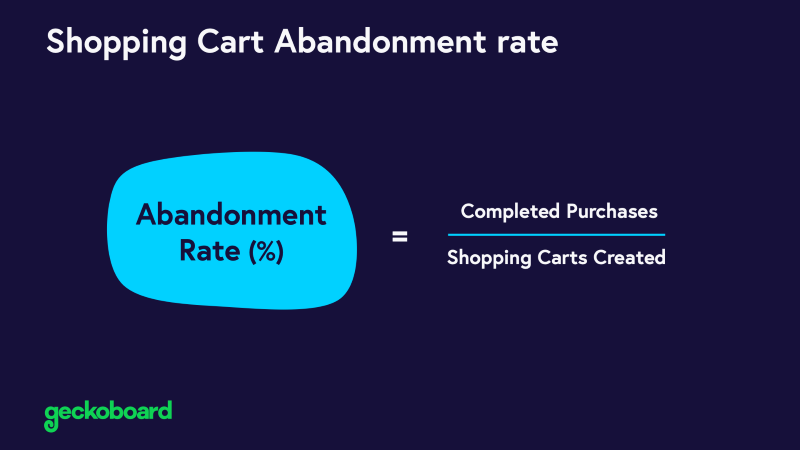
In line with Baymard Institute’s meta-analysis of fifty completely different research, the typical cart abandonment price is 70.22%. Meaning roughly 7 out of 10 customers who add objects to their cart go away with out shopping for.
The first causes customers abandon their carts:
| Purpose for Abandonment | Share |
|---|---|
| Additional prices too excessive (transport, taxes, charges) | 47-48% |
| Website needed buyer to create an account | 19-25% |
| Supply too sluggish | 21-24% |
| Didn’t belief web site with bank card | 18% |
| Checkout too lengthy or difficult | 17-22% |
| No most well-liked fee technique | 13% |
Have a look at that first purpose. Practically half of abandonments occur due to shock prices. That is fixable. Be clear about transport upfront; it’s that straightforward.
In line with Baymard’s checkout analysis, the typical large-sized ecommerce web site can acquire a 35.26% enhance in conversion price by higher checkout design alone.
How Does Conversion Charge Connect with Enterprise Technique?
Right here’s the mindset shift you want: profitability per customer issues greater than conversion price alone.
Think about this situation:
- Retailer A: 4% conversion price, $50 AOV, $2 revenue per customer
- Retailer B: 2% conversion price, $200 AOV, $4 revenue per customer
Retailer B is successful regardless of the “worse” conversion price. For this reason you must perceive your advertising and marketing ROI holistically. When constructing your ecommerce enterprise, your digital advertising and marketing technique ought to tie conversion optimization to CLV, buyer acquisition price, and total profitability, not simply chase an arrogance metric.
How Do You Enhance Your Ecommerce Conversion Charge?
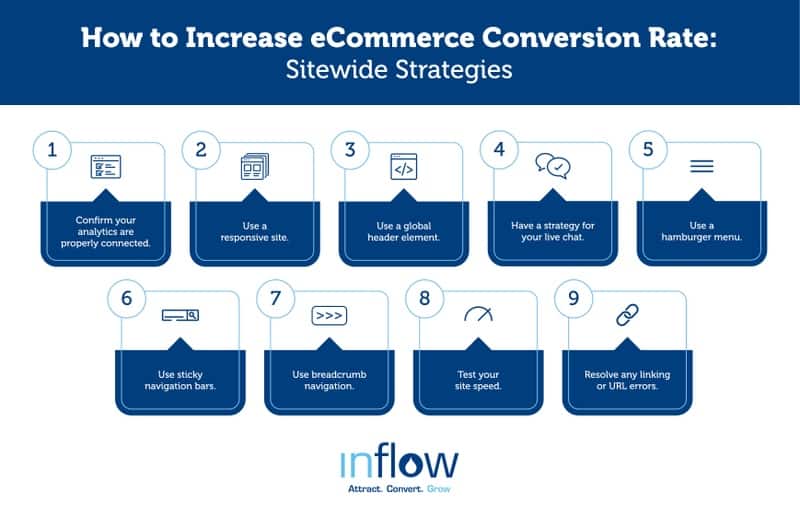
Enhancing conversion charges requires decreasing checkout friction, constructing belief by social proof and transparency, and utilizing personalization to match affords to purchaser intent. Most beneficial properties come from eradicating obstacles, not including options.
Let’s get tactical.
How Do You Take away Friction from the Shopping for Expertise?
Right here’s your friction-removal guidelines:
Checkout Optimization:
Website Pace:
- Pages ought to load in below 3 seconds (use Google PageSpeed Insights to check)
- In line with Loyally.ai’s analysis, in case your web site hundreds one second faster, your conversion price can enhance by 17%
- Compress pictures with out sacrificing high quality
- Think about a CDN for sooner international supply
Worth Transparency:
- Present transport prices early, ideally on the product web page
- Show all charges earlier than checkout
- Provide free transport thresholds (and make them outstanding)
Cell Expertise:
- Design mobile-first, not mobile-adapted
- Guarantee buttons are thumb-friendly
- Simplify navigation for smaller screens
I’ve written in regards to the significance of website positioning for ecommerce and web site efficiency, and these similar ideas apply to conversion. Quick, user-friendly websites win.
How Do You Construct Belief and Cut back Buy Nervousness?
TTrust is the invisible drive behind each conversion. Right here’s earn it:
Transparency:
- Show clear return and refund insurance policies (hyperlink them prominently)
- Present actual contact data
- Be upfront about transport occasions
Social Proof:
- Characteristic buyer testimonials prominently
- Show product opinions close to purchase buttons
- Present user-generated content material (UGC advertising and marketing is highly effective)
- Embrace belief badges and safety seals
Fee Safety:
- Show SSL certificates
- Provide acquainted fee choices (PayPal, Apple Pay, and so forth.)
- Present accepted card logos
In line with Baymard’s analysis, 18% of cart abandonment stems from bank card belief points. Just a few safety badges can straight impression your backside line.
How Can Personalization Drive Extra Conversions?
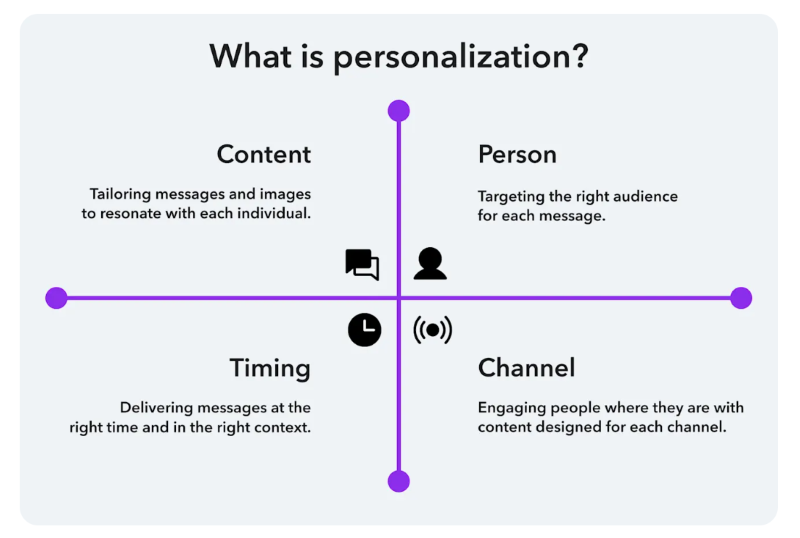
GGeneric experiences get generic outcomes. Personalization exhibits you perceive your buyer.
Behavioral Triggers:
- Advocate merchandise primarily based on shopping historical past
- Present “not too long ago considered” objects
- Counsel complementary merchandise at checkout
Urgency and Shortage:
- Show low-stock warnings (when real)
- Use time-limited affords strategically
- Present how many individuals are viewing an merchandise
E-mail Retargeting:
- Ship deserted cart emails (recovers 5-10% of misplaced gross sales)
- Personalize topic strains with product names
- Embrace product pictures and a direct hyperlink again
The advantages of AI in ecommerce embrace refined personalization at scale. Instruments now exist that make this accessible to companies of any measurement.
What Superior Methods Separate Prime Performers?
As soon as fundamentals are in place, superior techniques like systematic A/B testing, segmented buyer journeys, and high-ticket gross sales optimization create sustainable aggressive benefits.
How Ought to You Method A/B Testing?
Don’t guess. Take a look at. However take a look at strategically.
What to Take a look at:
- Headlines and worth propositions
- CTA button textual content, shade, and placement
- Product picture layouts
- Pricing show (month-to-month vs. annual)
- Type size and discipline order
Testing Greatest Practices:
- Begin with high-impact parts (headlines, CTAs)
- Run assessments lengthy sufficient for statistical significance
- In line with Pink Stag Success, you want no less than 1,000 conversions per take a look at variant to achieve statistical significance
- Take a look at one variable at a time
- Doc every thing and construct institutional information
The businesses successful at ecommerce deal with testing as a steady course of, not a one-time undertaking.
How Do You Optimize for Excessive-Ticket Gross sales?
Excessive-ticket merchandise require completely different techniques:
| Low-Ticket Ways | Excessive-Ticket Ways |
|---|---|
| Fast checkout | Prolonged consideration content material |
| Urgency-driven CTAs | Belief-building content material |
| Easy product pages | Detailed specs + video |
| Self-service | Reside chat with consultants |
| One-time buy focus | Financing choices |
For costly objects, think about:
- Video demonstrations and digital excursions
- Reside chat help throughout enterprise hours
- Comparability guides in opposition to opponents
- Financing/fee plan choices
- Prolonged guarantee data
The belief hole is bigger for high-ticket purchases. Your content material wants to shut that hole earlier than the conversion can occur. Try ecommerce pictures suggestions for making merchandise shine.
What Analytics Instruments Ought to You Use?
The suitable ecommerce instruments make information actionable:
I like to recommend beginning with Google Analytics 4 and a heatmap instrument. These two alone reveal 80% of what you must know.
The Neal Schaffer CRO Framework for Strategic Development
After years of working with ecommerce manufacturers, right here’s my tried-and-true strategy:
- Audit visitors high quality — Not all guests are equal. Analyze by supply and intent.
- Diagnose funnel leaks — Use segmented KPIs to search out the place prospects drop off.
- Evaluation message-market match — Is your touchdown web page copy aligned with advert guarantees?
- Implement hypothesis-driven testing — Take a look at primarily based on information insights, not random guesses.
- Tie every thing to enterprise KPIs — Income, buyer acquisition price, and CLV matter most.
This framework has helped shoppers throughout industries, from Shopify website positioning optimization to Amazon advertising and marketing methods. The ideas stay fixed.
What Conversion Charge Optimization Errors Ought to You Keep away from?
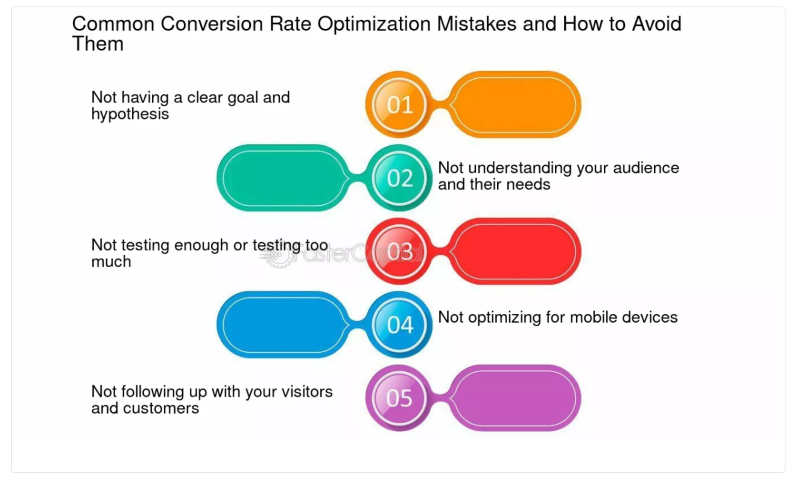
Even sensible entrepreneurs make these errors:
Copying Opponents Blindly: What works for them could not work in your viewers. Their prospects aren’t your prospects.
Obsessing Over Button Colours: Spend your power on messaging and supply readability, not whether or not your CTA ought to be orange or inexperienced.
Ignoring Cell: If 60%+ of your visitors is cell and your cell expertise is mediocre, nothing else issues.
Forgetting Emotional Friction: Buy choices aren’t purely rational. Deal with fears, uncertainties, and doubts straight.
Optimizing for Conversion Charge Alone: A 5% conversion price means nothing if you happen to’re attracting low-value prospects who by no means return.
When selecting between platforms like Shopify or WooCommerce, think about which provides you higher conversion optimization capabilities in your particular wants.
Steadily Requested Questions About Ecommerce Conversion Charges
A superb ecommerce conversion price in 2026 ranges from 2.5% to three.2%, with top-performing shops attaining 4-5% or greater. Nevertheless, this varies considerably by {industry}. Meals and beverage manufacturers sometimes see 5-6%, whereas luxurious items convert at 1-1.5%. Examine your price in opposition to your particular {industry} benchmark slightly than total averages.
Low conversion charges regardless of excessive visitors often point out a mismatch between your viewers and supply. Frequent causes embrace poor cell expertise, unclear worth propositions, hidden transport prices, difficult checkout processes, or attracting the flawed visitors by misaligned advertisements. Begin by analyzing your funnel to establish the precise drop-off level.
In line with Baymard Institute’s analysis, the typical giant ecommerce web site can acquire as much as 35% enchancment in conversion price by checkout design enhancements alone. Easy fixes like providing visitor checkout, decreasing kind fields, and displaying all prices upfront can recuperate important misplaced income.
Sure, cell apps convert roughly 3x greater than cell web sites. Apps present sooner loading, higher consumer expertise, push notification capabilities, and saved fee data that reduces checkout friction. If cell visitors is important for your corporation, an app could also be well worth the funding.
Conversion optimization ought to be an ongoing course of, not a one-time undertaking. Run steady A/B assessments on high-impact parts like headlines, CTAs, and checkout flows. Most companies profit from having no less than one take a look at working always, with outcomes reviewed month-to-month. Prioritize assessments primarily based on potential income impression and visitors quantity.
Able to Remodel Your Ecommerce Conversion Charge?
Your ecommerce conversion price is a mirror reflecting how properly your corporation understands its viewers, worth proposition, and digital expertise.
Right here’s my problem to you: Cease chasing generic benchmarks. Begin creating experiences that convert your distinctive visitors into loyal, repeat prospects.
Whether or not you’re promoting luxurious items or client merchandise, conversion optimization is rarely “achieved.” It’s an ongoing course of that bridges analytics, empathy, and motion.
Concentrate on:
- Understanding your particular viewers deeply
- Eradicating each pointless friction level
- Constructing belief at each touchpoint
- Testing repeatedly and studying always
- Measuring success holistically, not simply by conversion price
That’s the way you win in ecommerce. And that’s the way you place your model for long-term, worthwhile development.
Able to take your ecommerce advertising and marketing to the subsequent degree? Begin by auditing your present conversion price by machine and channel. The insights may shock you. For strategic steering, discover my Digital First Group Teaching Neighborhood or obtain my free Advertising and marketing Instruments Information to establish the suitable instruments in your conversion optimization stack. And if you happen to want hands-on strategic assist, don’t hesitate to attain out.
Actionable recommendation in your digital / content material / influencer / social media advertising and marketing.
Be a part of 13,000+ sensible professionals who subscribe to my common updates.
