




I’ve been publishing on LinkedIn for the reason that platform was sufficiently small that you would acknowledge a lot of the energetic voices by title. Three books later, a decade of operating social media coaching at Rutgers Enterprise College, and someplace north of a thousand posts on the platform, the query I get requested most frequently by shoppers, teaching members, and viewers members after a keynote is identical one: how do I write a LinkedIn publish that individuals truly see?
In 2026, that query is tougher to reply than it was even a yr in the past. LinkedIn rebuilt the underlying rating system for its feed, changing a number of separate retrieval pipelines with a single LLM-powered mannequin that judges your publish on topical relevance to every viewer relatively than on uncooked connection overlap.
The platform now serves roughly 1.3 billion members, and guardian firm Microsoft confirmed LinkedIn’s continued momentum in its Q3 FY26 earnings press launch, reporting double-digit LinkedIn income progress throughout all traces of enterprise.
The sensible impact for content material creators is easy: posts that match your established experience space and earn significant engagement within the first hour journey a lot additional than they used to. Posts that look generic or off-topic get filtered earlier than most of your community ever sees them.
This information is the playbook I take advantage of myself, train in my course, and stroll shoppers by way of after I’m working with them as a Fractional CMO. It pulls from the 2026 second version of Maximizing LinkedIn for Enterprise Progress, conversations with model groups I’ve suggested, and the newest platform analysis I belief.
Key Takeaways
✅ A LinkedIn publish is short-form content material (as much as 3,000 characters) printed to the feed, with seven dominant codecs: textual content, single picture, multi-image gallery, doc carousel, ballot, native video, and reshare with commentary.
✅ The primary 140-210 characters are the whole sport. Cell cuts off at roughly 140 characters; desktop at about 210. Your hook has to land contained in the cutoff or the remainder of the publish received’t get learn.
✅ Engagement peaks for posts within the 1,300-2,500 character vary, with engagement falling off for posts underneath 400 or pushing towards the three,000 ceiling.
✅ Carousels (PDF doc posts) are the highest-engagement format on LinkedIn by a large margin, adopted by native video and picture posts. Textual content-only posts are the simplest to publish however the lowest-engagement format.
✅ Posting 2 to five instances per week is the significant tier shift; beneath that, the algorithm doesn’t deal with you as an energetic creator.
✅ Subject consistency and profile-content alignment at the moment are main rating components. The 2026 algorithm reads your profile, appears at your posting historical past, and may route your publish to folks whose pursuits align, even when they don’t observe you.
What Is a LinkedIn Put up (And Why Does It Look Completely different in 2026)?
A LinkedIn publish is a short-form replace printed to the feed, as much as 3,000 characters, that the platform’s algorithm distributes to a subset of your community and (more and more) to non-followers whose skilled pursuits match the subject. Not like a LinkedIn article, a publish is constructed for quick consumption contained in the scroll, and the algorithm scores it as standalone content material by itself.
What’s modified in 2026 is the half the algorithm cares about. For years, LinkedIn’s feed leaned on connection-based distribution: publish one thing, your followers see it first, and if just a few of them have interaction, it expands outward by way of their networks. That mechanic nonetheless exists, nevertheless it’s not the first driver.
LinkedIn’s engineering workforce disclosed in March 2026 that the platform changed a number of rating pipelines with a unified LLM-based retrieval and rating system. The brand new mannequin builds embeddings of each posts and customers, then matches content material to viewers based mostly on semantic understanding of the subject relatively than direct relationship. In keeping with the engineering replace protection, the brand new structure can retrieve candidates in underneath 50 milliseconds and updates content material embeddings inside minutes.
The broader strategic path has been telegraphed for years. Tim Jurka, then a senior director of engineering at LinkedIn, wrote in 2024 that the platform needs its content material targeted on relevance relatively than virality, which means the suitable folks getting probably the most related information relatively than the biggest attainable viewers.
In plain English: should you publish about B2B SaaS pricing, LinkedIn now makes use of the LLM to know that B2B SaaS pricing pertains to income operations, freemium technique, and CFO decision-making. It may possibly floor your publish to a CFO in your second-degree community who has been partaking with pricing-strategy content material all week. That CFO doesn’t must observe you.
The system additionally weighs your personal profile as a credibility sign. In case your About part, headline, and posting historical past align with the subject of your publish, you get rewarded. In the event that they don’t, you get throttled.
That type of skilled studying habits is extra frequent than most individuals assume: Sprout Social’s 2026 LinkedIn evaluation experiences that just about 70% of LinkedIn customers have interaction with model content material a minimum of as soon as every week.
That final level issues greater than most individuals notice. My publish on LinkedIn headline examples is the place I cowl the foundational profile work as a result of the headline is the place the algorithm and the human reader each resolve whether or not you’ve gotten authority on what you simply posted about. A weak or off-topic headline now actively suppresses your publish attain.
What Are the Completely different Kinds of LinkedIn Posts?
LinkedIn helps seven main publish codecs, every with its personal engagement profile and best-use case. In my e-book I argue that almost all professionals ought to grasp three or 4 of those and skip the remainder relatively than spreading skinny throughout all seven.
Is Your LinkedIn Not Delivering Outcomes?
Simply launched: my new e-book to assist professionals, entrepreneurs, and enterprise homeowners maximize LinkedIn for actual progress.
With years of LinkedIn experience, Maximizing LinkedIn for Enterprise Progress presents actionable steps to construct your model, broaden your community, and drive outcomes.
Begin leveraging LinkedIn like by no means earlier than—seize your copy now! Click on the quilt or button beneath to purchase on Amazon.

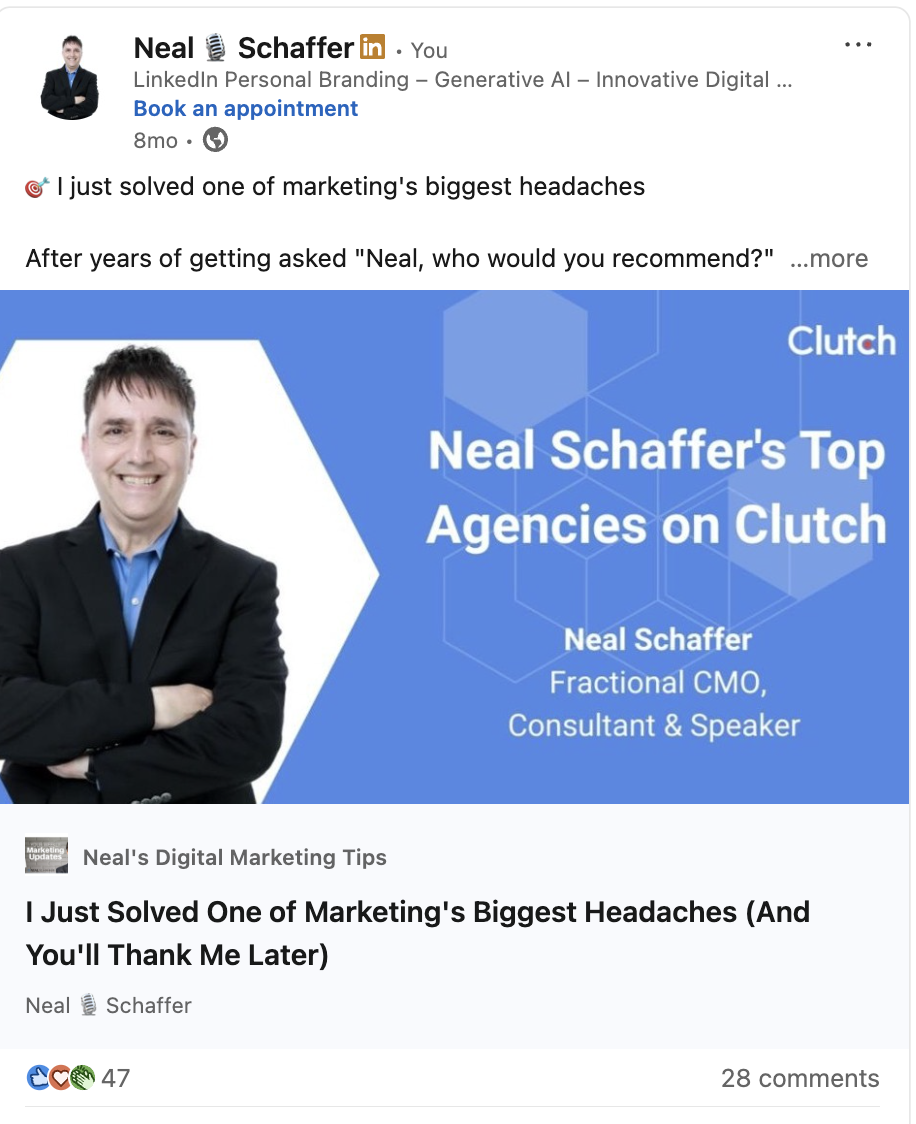
The seven codecs most professionals will truly use are the plain textual content publish, the only picture publish, the multi-image gallery, the doc carousel (PDF), the ballot, the native short-form video, and the reshare with added commentary. There’s additionally LinkedIn Dwell, the LinkedIn Article (long-form), and the LinkedIn E-newsletter, that are adjoining merchandise with their very own distribution guidelines however might be cross-posted as feed content material too. E-newsletter shares specifically have develop into a dependable performer for me when I’ve a recent version to advertise, as a result of they pull in two engagement audiences directly: the subscribers who get the push notification and the broader feed readers who see the share.
Right here’s how the foremost codecs examine on engagement, based mostly on Buffer’s evaluation of greater than 2 million LinkedIn posts throughout its 94,000+ linked accounts:
| Put up Format | Relative Engagement (vs. Textual content) | Finest For | Effort Stage |
|---|---|---|---|
| Doc Carousel (PDF) | ~600% extra engagement | Frameworks, checklists, step-by-step content material readers will save | Excessive |
| Native Video | 84% extra engagement | Founder POV, behind-the-scenes, interviews | Excessive |
| Single Picture / Multi-Picture | 72% extra engagement | Selfie-with-context posts, convention pictures, milestones | Low |
| Textual content Put up | Baseline | Fast insights, polarizing takes, questions | Low |
| Ballot | Variable (excessive remark fee) | Viewers analysis, light-weight engagement | Low |
| Reshare with Commentary | Decrease than authentic posts | Amplifying consumer/colleague wins, information commentary | Very low |
| Posts with Exterior Hyperlinks | Lowest median engagement | Typically keep away from; put hyperlink in first remark as a substitute | Low |
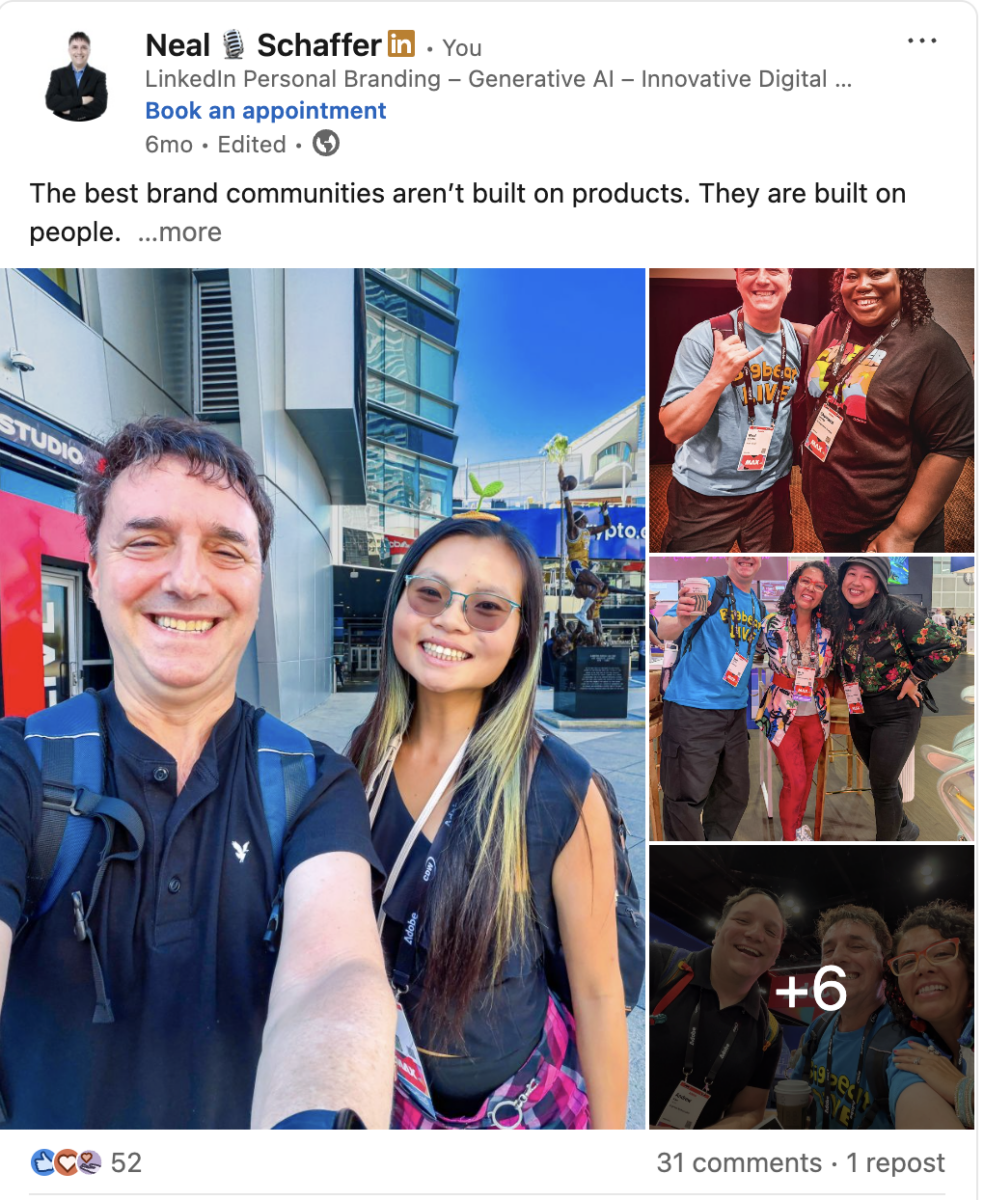
Just a few notes from my very own posting that the desk doesn’t seize. The selfie-with-context publish is genuinely underused. After I’ve posted a photograph of myself at a consumer go to, a convention, and even my residence workplace desk with just a few sentences of context, these posts persistently outperform something pre-planned.
I cowl this intimately in Maximizing LinkedIn for Enterprise Progress the place I break up content material into “skilled” and “engagement” buckets. Engagement content material (the human aspect, the celebration, the private milestone) persistently outperforms pre-planned thought management in my very own analytics, each single week.
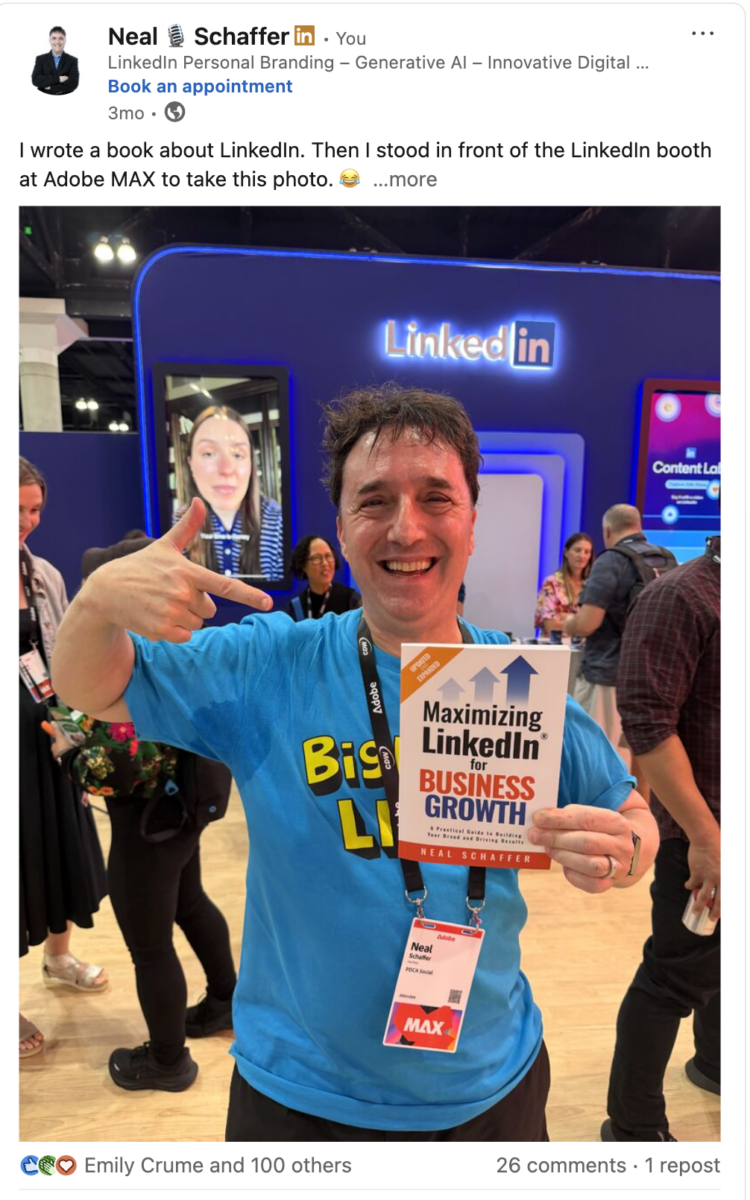
The carousel-versus-everything-else hole is corroborated by a second giant dataset: Socialinsider’s 2026 benchmark evaluation of 1.3 million LinkedIn enterprise posts put native doc posts at a 7.00% common engagement fee, the best of any format on the platform, with a 14% year-over-year efficiency improve. Two unbiased research, two completely different methodologies, similar conclusion.
The format hole between carousels and every little thing else is actual nevertheless it comes with a caveat. Carousels take meaningfully longer to provide than a textual content publish or a selfie, and should you’ve by no means made one earlier than, the design studying curve is steep.
I’ve written extra concerning the manufacturing specifics on the LinkedIn carousel publish format, however the quick model is: design 5 to 10 swipeable PDF pages in Canva or Adobe Categorical, add as a doc, and write commentary within the publish physique. That single change in format alone has been probably the most dependable engagement carry I’ve seen for shoppers who had been caught on textual content posts.
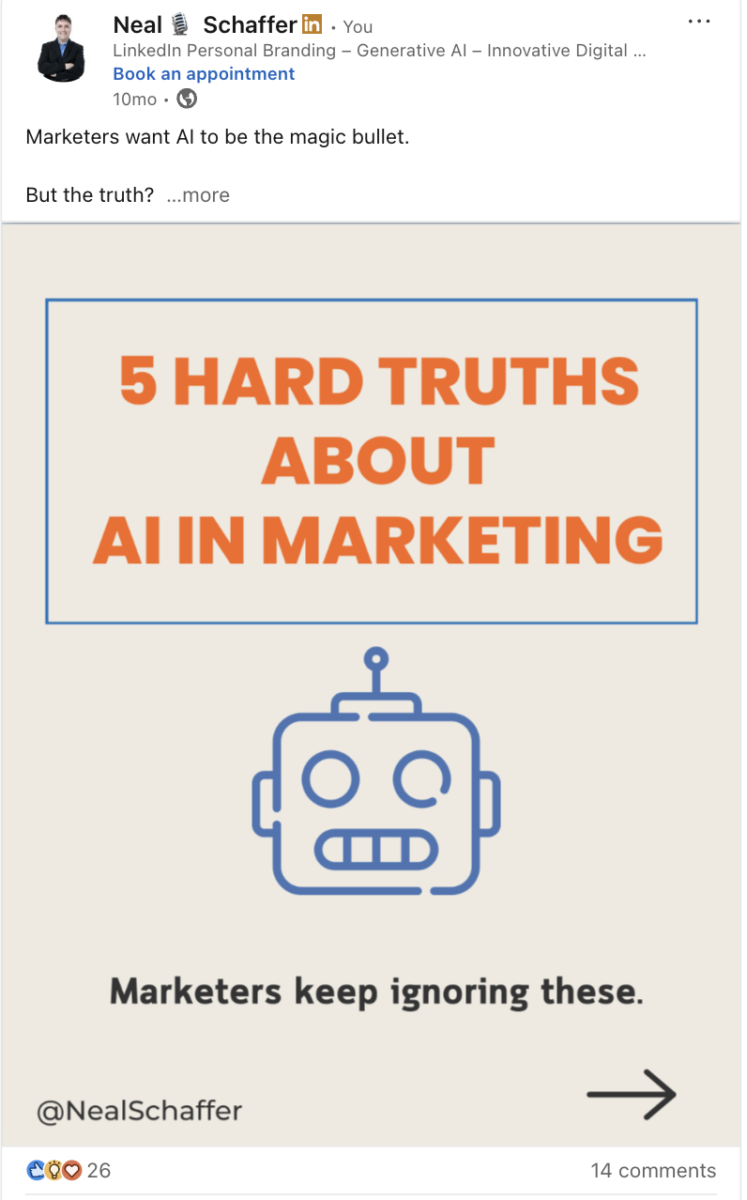
Polls stay helpful in 2026 however they’re a special beast. They get huge engagement (the best remark charges of any format), however they don’t carry the identical authority sign {that a} substantive publish does. Don’t make your weekly content material rotation 50% polls and anticipate to construct a critical skilled model. I cowl when polls truly work on my protection of LinkedIn polls.
How Do You Write a LinkedIn Put up That Truly Will get Engagement?
A high-performing LinkedIn publish in 2026 follows a four-part construction: a hook that lands contained in the cell preview cutoff (roughly 140 characters), a particular worth proposition within the subsequent two traces, the substantive content material (story, framework, or argument), and a closing query that invitations a reply. And not using a hook that earns the press on “see extra,” nothing else issues.
The hook is the only most necessary sentence you’ll write. AuthoredUp’s evaluation of 372,126 LinkedIn posts printed between September 2025 and February 2026 discovered that posts underneath 400 characters underperform on each metric, with median engagement charges of two.10% versus 2.61-2.67% for posts within the 1,301-2,500 character vary.
However size solely helps if folks learn previous the primary line. The hook must both break a sample (state one thing contrarian to what most readers anticipate), create a curiosity hole (open a loop the reader wants to shut), or title a particular ache level within the viewers’s actual language.
Hooks that I’ve seen persistently outperform in my very own posting and in consumer accounts I’ve audited fall into 4 dependable patterns:
| Hook Sample | What It Does | Instance Opening Line |
|---|---|---|
| Counterintuitive quantity | Particular stat plus an surprising body | “I closed $4M in pipeline final quarter with out sending a single chilly electronic mail. Right here’s what truly labored.” |
| Contradiction of typical knowledge | Names a standard perception and rejects it | “Cease optimizing your LinkedIn headline. It’s the third factor recruiters learn, not the primary.” |
| Confession / vulnerability | Admits a mistake or surprising consequence | “I deleted three years of LinkedIn content material final week. Engagement went up.” |
| Sample-interrupt remark | Names the reader’s actual expertise | “Most LinkedIn posts lose the reader earlier than ‘see extra.’ Mine used to.” |
What does NOT work in 2026:
- “I’m excited to announce…”: common scroll set off
- “Scorching take:”: pattern-matched as engagement bait
- “Remark YES should you agree”: actively suppressed by the algorithm
- Any generic “in immediately’s [adjective] world” opener: immediately indicators AI-generated content material
- Any publish that opens with a generic dictionary-style definition
Observe that LinkedIn has been specific about decreasing the attain of engagement-bait content material in 2026. The platform’s March replace flagged three particular patterns it might actively suppress: posts that explicitly solicit a one-word reply for algorithmic carry, posts that pair an attention-grabbing video with unrelated textual content to govern distribution, and templated thought-leadership content material that recycles the identical construction throughout many accounts with out including authentic perception.
Getting again to the LinkedIn publish mechanics, after the hook, the publish must ship. The 2 buildings that work reliably:
The Story → Lesson construction. Open with a particular second (a gathering, a choice, a failure), narrate the related element in 200-400 phrases, then finish with the lesson generalized for the reader. This works for private model posts and B2B credibility content material equally properly.
The Framework / Listing construction. Open with the hook, title the framework or the variety of objects, ship them with quick paragraphs and line breaks, and shut with a “right here’s what to do this week” immediate. That is the construction that will get bookmarked, and saves at the moment are one of many strongest indicators the algorithm tracks.
Both method, your formatting selections matter. Use single-sentence paragraphs and aggressive line breaks. Partitions of textual content get scrolled previous. Emojis used sparingly (one or two as visible anchors, not as ornament) are tremendous. Hashtags have misplaced most of their distribution worth in 2026 as a result of the algorithm now makes use of semantic matter modeling relatively than hashtag matching; use three to 5 related ones for gentle categorization however don’t anticipate them to drive attain.
Finish with a query that offers readers a low-friction motive to remark. Not “Do you agree?” however “What’s the one factor your workforce does on LinkedIn that you simply suppose different groups ought to copy?” Specificity invitations a substantive remark, and substantive feedback are what the 2026 algorithm weighs most closely.
How Lengthy Ought to a LinkedIn Put up Be?
In keeping with AuthoredUp’s evaluation, the optimum LinkedIn publish size in 2026 is between 1,300 and a couple of,500 characters, which interprets to roughly 250 to 450 phrases. Posts on this vary generate the best median engagement charges on the platform, whereas posts underneath 400 characters underperform on impressions and posts pushing the three,000-character ceiling present slight engagement decline relative to the two,001-2,500 vary.
What meaning in apply is that the three,000-character restrict is a ceiling, not a goal. The platform provides you the room as a result of some content material (lengthy private tales, detailed frameworks, contrarian arguments) genuinely wants it. However probably the most dependable performers are tight, scannable, and constructed round a single clear thought.
Right here’s how size intersects with content material sort, based mostly by myself posting and the information:
| Content material Sort | Beneficial Size | Notes |
|---|---|---|
| Fast perception or business remark | 200-500 characters | Compact, share an opinion, invite a fast response |
| Query or viewers immediate | 100-300 characters | Query is the worth; minimal context wanted |
| Framework or listing (3-7 objects) | 1,300-2,000 characters | A number of line breaks; every merchandise will get its personal visible beat |
| Private story or case examine | 1,500-2,500 characters | Room for narrative arc; particular particulars |
| Detailed perspective / contrarian argument | 1,800-2,500 characters | Construct the argument rigorously; cite proof |
| Carousel commentary (publish physique) | 200-400 characters | A lot of the substance is within the PDF itself |
One nuance the character-count knowledge doesn’t totally seize: completion fee. LinkedIn’s March 2026 engineering disclosure lists dwell time among the many indicators the brand new rating mannequin analyzes alongside likes, feedback, and different interactions, which means the longer somebody truly spends studying your publish, the stronger the engagement sign.
How Usually Ought to You Put up on LinkedIn?
The best LinkedIn posting frequency for many professionals is 2 to 5 posts per week, with the algorithm rewarding the bounce from one publish per week to two-plus greater than some other frequency change. The identical Buffer dataset discovered that this single cadence shift, greater than some other, is what triggers the platform to deal with you as an energetic creator and start distributing your content material extra broadly.
The Buffer dataset, controlling for account dimension and area of interest, discovered three significant tiers of return on posting cadence. At two to 5 weekly posts, accounts gained a further 1,182 impressions per publish on common and noticed their engagement fee climb 0.23 proportion factors relative to once-weekly posting. Pushing into the six-to-ten vary pulled these numbers increased: 5,001 further impressions per publish and a 0.76 proportion level engagement fee improve. Accounts operating eleven or extra posts per week noticed the steepest climb of all, including 16,946 impressions per publish, tripling whole engagements, and lifting engagement fee by 1.40 factors.
The takeaway is that LinkedIn behaves in another way from most different platforms on the subject of posting cadence. There’s no observable penalty for top frequency, and every step up in quantity tends to widen relatively than dilute distribution. Social Media Immediately’s protection of the identical Buffer examine framed this because the algorithm “rewards exercise” impact, the place increased posting quantity indicators the system to floor extra of your content material to extra viewers.
That stated, I might not suggest most professionals bounce from one publish every week to eleven. The reasonable working cadence I see succeed for shoppers is three to 4 posts per week, alternating codecs (one carousel, two textual content posts, one selfie-with-context or video). That cadence is sustainable, enables you to batch content material manufacturing, and hits the engagement-rate candy spot with out burning out.
A separate query that issues as a lot as frequency is when to publish. The final rule throughout most B2B audiences is Tuesday by way of Thursday between 9 a.m. and midday native time, although there’s important variation by business and viewers time zone. I’ve printed extra on the very best time to publish on LinkedIn, however the larger lever for many accounts is consistency over exact timing. The algorithm rewards a predictable schedule as a result of it has extra knowledge to work with on how your particular viewers engages.
One nuance particular to 2026 value flagging: the outdated “24-hour window” rule of thumb for LinkedIn publish lifespan is being actively rewritten. “Proper now, content material lives and dies on the newsfeed in a short time,” Tim Jurka, LinkedIn’s senior director of engineering, informed Entrepreneur journal.
The platform is now constructing a system to floor high-quality posts to related viewers lengthy after their authentic publication date, treating robust posts extra as sturdy belongings than disposable updates. The sensible implication for you: write every publish prefer it might hold working for you over the lengthy haul, as a result of the platform more and more needs it to.
What Does the LinkedIn Algorithm Reward in 2026?
The LinkedIn algorithm in 2026 rewards three issues above all else: topical relevance to the viewer, engagement high quality (particularly substantive feedback and saves), and profile-content alignment. It actively suppresses engagement bait, off-topic posting that breaks out of your established experience, and content material that pattern-matches as AI-generated boilerplate.
5 particular indicators matter most:
Subject consistency and profile credibility. The system reads your headline, About part, and up to date posting historical past earlier than distributing your publish. When you publish about provide chain optimization however your profile says you’re a marriage photographer, the algorithm doesn’t know who to route the publish to and your attain will get capped. The repair is editorial self-discipline: decide two or three matter areas and publish persistently inside them.
Engagement velocity within the first 60-90 minutes. Like most different social networks, LinkedIn reveals your publish to a small preliminary slice of your community first, then watches how these viewers have interaction earlier than deciding whether or not to widen distribution. Substantive feedback, saves, and shares in that window matter excess of likes. The algorithm now clearly distinguishes between energetic engagement (feedback, shares, direct messages) and passive engagement (reactions, views), closely favoring the previous. That is why the half-hour earlier than and after you publish are value investing in: remark substantively on three to 5 posts in your community, reply to early feedback by yourself publish throughout the first hour, and the algorithm reads all of it as relationship sign.
Saves over likes. Saves are broadly understood amongst LinkedIn creators and platform researchers to hold meaningfully extra weight than likes or reactions, on the logic {that a} save indicators lasting reference worth relatively than momentary curiosity. The sensible takeaway: construction your content material as one thing a reader would bookmark to refer again to later. Frameworks, checklists, step-by-step guides, and comparability tables get saved. Scorching takes and fast observations get a thumbs-up and a scroll.
Dwell time. LinkedIn’s engineering workforce has described dwell time (how lengthy a reader spends on the publish, even with out clicking or commenting) as one of many indicators the brand new rating mannequin analyzes.
No engagement bait. The 2026 algorithm is particularly tuned to detect and suppress posts that explicitly solicit reactions (“Remark YES should you agree”), in addition to recycled thought-leadership templates that pattern-match throughout many accounts. I dig into the measurement aspect of this in my LinkedIn analytics publish.
For deeper evaluation of how these indicators stack right into a coordinated technique, my publish on LinkedIn advertising technique lays out a whole posting framework, and my LinkedIn greatest practices publish is the place to start out for foundational profile and behavioral hygiene earlier than optimizing for the algorithm. The underlying numbers (natural attain developments, format-specific engagement charges, and the most recent member counts) all sit on my publish on LinkedIn statistics, which I refresh on an everyday cadence.
What Are the Greatest LinkedIn Put up Errors to Keep away from?
Probably the most damaging LinkedIn publish errors in 2026 are posting off-topic content material that breaks out of your established experience, opening with a generic “see extra” cutoff, utilizing engagement-bait phrasing, together with exterior hyperlinks within the publish physique as a substitute of within the first remark, and treating LinkedIn like a broadcast channel relatively than a community.
Particular errors I see most frequently when auditing consumer accounts:
The “We’re excited to announce” opener. In case your first line might seem on the prime of a company press launch, your publish goes to die. The opener needs to be human, particular, and curiosity-inducing. Even a serious firm milestone advantages from a private framing: “Two years in the past I informed my co-founder this could by no means work. We simply shipped it.”
Wall-of-text formatting. A LinkedIn publish that appears like a paragraph from a novel is a scroll set off. Single-sentence paragraphs, aggressive line breaks, and the occasional bullet listing are all that stand between an extended publish and the reader. White area is a characteristic, not a flaw.
Posting hyperlinks within the publish physique. Exterior hyperlinks within the publish physique get diminished distribution as a result of LinkedIn doesn’t need customers leaving the platform. The workaround the highest creators use: drop the hyperlink within the first remark, and check with it within the publish physique (“Hyperlink within the first remark”).
Treating LinkedIn like one-way broadcast. Posts carry out higher after they’re surrounded by engagement exercise from the writer. When you publish a publish after which don’t touch upon anybody else’s content material for the following 24 hours, you’re leaving distribution on the desk. Spend quarter-hour commenting substantively on related posts in the identical window you publish, and the algorithm reads it as relationship sign that advantages each your publish and your visibility on theirs.
Inconsistent matter combine. In case your final ten posts are about advertising technique and your eleventh publish is a couple of political controversy, the system loses its learn on who to distribute that publish to, and the publish underperforms even when the content material is sweet. Keep inside your two or three established lanes. Save the off-topic content material for private social channels or put it aside for posts the place you may join it again to your skilled theme.
Generic AI-generated drafts. This one is generally a 2026 downside. LinkedIn’s content material classifier has gotten higher at detecting boilerplate AI output, and posts that pattern-match as generic ChatGPT drafts are receiving diminished attain. AI is okay as a drafting device (I take advantage of it repeatedly), however the closing publish wants your voice, a particular anecdote, and a perspective a machine couldn’t have generated.
Regularly Requested Questions
Three to 5 related hashtags is the higher restrict value utilizing. The 2026 algorithm distributes content material based mostly on LLM-derived matter modeling relatively than hashtag matching, so hashtags carry far much less weight than they did in 2022 or 2023. Use them for gentle categorization, not as a distribution technique. Stuffing 15+ hashtags won’t enhance attain and will sign low-quality content material to the classifier.
Not within the publish physique. Put the hyperlink within the first remark and reference it within the physique (“Hyperlink to the complete piece within the first remark”). That is the workaround the platform’s prime creators have settled on as a result of exterior hyperlinks within the publish physique itself obtain diminished distribution, whereas hyperlinks within the first remark don’t.
A LinkedIn publish is short-form content material as much as 3,000 characters printed to the feed, designed for quick consumption contained in the scroll. A LinkedIn article is long-form (as much as 125,000 characters), has its personal devoted web page on LinkedIn, can rank in Google search outcomes, and behaves extra like a weblog publish.
Posts get distributed to the feed; articles can construct a subscriber base by way of LinkedIn Newsletters. The publishing mechanics for each stay on my learn how to publish on LinkedIn publish, and the long-form format has its own residence right here on my publish about LinkedIn articles.
The viewers is generally cell, however the format implications matter. Cell cuts off the publish preview at roughly 140 characters; desktop at round 210. When you’re writing your hook on desktop and it appears nice at 200 characters, cell customers should still see a truncated model. Check the primary line on a cellphone earlier than publishing something you care about.
Longer than it used to. The outdated rule of thumb was 24 hours, and the 2026 algorithm is constructed to increase that meaningfully. The platform is actively creating capabilities to floor high-quality posts to related viewers lengthy after their authentic publication date, as a part of an effort to make the feed much less time-bound and extra knowledge-bound. The precise lifespan extension varies by publish and viewers sign, so deal with robust posts as sturdy belongings relatively than disposable updates.
Able to Begin Publishing LinkedIn Posts That Get Seen?
A very powerful shift to make this month is transferring from one publish per week to 2 or three. Choose two subjects the place you’ve gotten actual experience, decide to publishing two or three posts every week inside them for the following 30 days, and watch which codecs your viewers responds to. The Buffer knowledge and my very own consumer work agree: cadence is the lever every little thing else activates.
If you would like a coordinated method to utilizing LinkedIn for B2B pipeline (which is the place a lot of the platform’s business worth sits), my publish on LinkedIn lead era is the next move. When you’d like assist constructing a coordinated LinkedIn presence as a part of a broader digital technique, attain out about my Fractional CMO companies, or obtain a free preview of Digital Threads for the playbook on integrating LinkedIn right into a multi-channel digital advertising program.
Actionable recommendation on your digital / content material / influencer / social media advertising.
Be a part of 13,000+ good professionals who subscribe to my common updates.
