



A Pinterest profile that’s grouped like a library catalog makes discovery simple. When boards observe clear key phrase themes, folks discover what they got here for quicker, and Pinterest can higher perceive the place your content material belongs. As Pinterest Enterprise notes, 97% of high searches on Pinterest are unbranded—clear topical construction helps you meet open-minded searchers proper after they’re deciding what to click on.
Why board construction instantly impacts attain
Pinterest doesn’t simply index Pins. It interprets Pins within the context of boards—titles, descriptions, and the neighboring Pins. Clustering boards by coherent themes sends constant alerts to the system and offers guests a frictionless path by means of your content material. As highlighted by Pinterest’s creator workforce, virtually 25% of Pinterest’s web optimization site visitors goes to boards—board readability isn’t beauty; it’s distribution. A well-named board helps Pinterest join a Pin to the suitable queries and adjoining concepts.
Deal with boards as matter hubs. When the board title, description, and pictures all categorical the identical concept, Pinterest can match your Pins to intent-driven searches extra reliably. For foundational setup (when to merge, how you can prioritize boards), use our primer on Pinterest board technique; this submit focuses particularly on clustering.
A centered board like “Price range DIY Decor” outperforms a generic “DIY Dwelling Decor” mash-up as a result of the search intent is unambiguous. Clustering prevents your individual boards from competing with one another and creates a path for customers to maintain exploring intently associated concepts.
The science of keyword-themed clusters
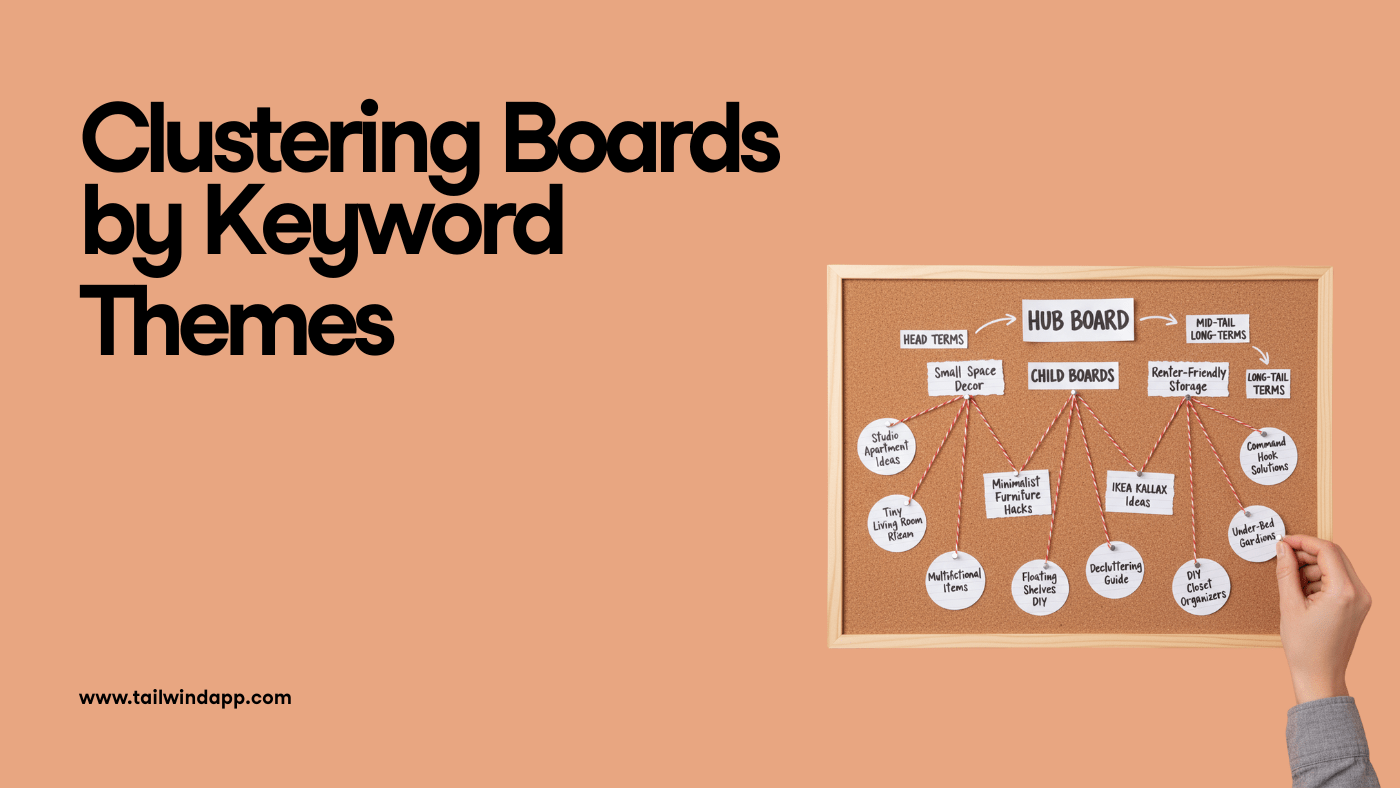
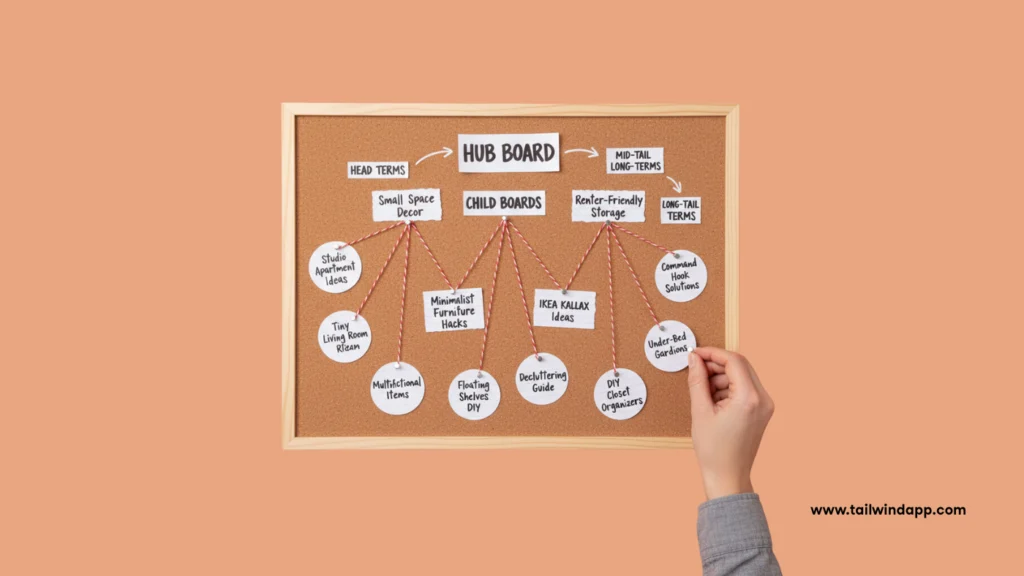
A cluster is a mother or father matter supported by area of interest subtopics. Architect it like website taxonomy: a hub (head time period), youngster boards (mid-tails), and serial content material (long-tail angles) that every one level again to the identical concept.
Instance cluster. Hub: Small Area Decor. Kids: Studio House Concepts, Minimalist Furnishings Hacks, Renter-Pleasant Storage. Every youngster board makes use of crisp naming and matching descriptions; Pins stay the place intent lives. This isn’t about stuffing synonyms; it’s about mapping entities and modifiers and the way photographs and language reinforce one another.
Do the analysis as soon as, then pipeline it into boards. Begin with Pinterest Key phrases: The Final Information.
Subsequent, use the superior key phrase pipeline in our Pinterest web optimization in 2025 playbook. Group phrases by intent (how-to, concepts, product) and specificity (head → mid → lengthy). These buckets map cleanly to hub/youngster/sequence—your cluster logic. If you happen to’re constructing broader matter clusters for Pinterest, preserve edges tight so every youngster addresses a definite job-to-be-done.
When a number of boards affirm the identical theme—with out duplicating intent—Pinterest “learns” to belief you in that space. New Pins on the theme begin on firmer footing, and associated Pins distribute throughout the grouping as a substitute of bottlenecking on a single board. For semantic grouping and an entity mindset, skim the latent semantic Pinterest primer earlier than you title something.
Re-clustering present boards (and not using a scorched-earth reset)
We’re not re-teaching UI clicks—manage, merge, and rename covers the mechanics. Right here, concentrate on clustering choices that make these edits rely.
Audit for intent (not simply efficiency). Construct a fast desk with impressions, saves, CTR, follower provides—and add two columns: goal intent and overlap flags. If two boards reply the identical search intent, plan a consolidation. If a board is efficacious however unfocused, plan a retarget: rename, rewrite the outline, and refit consultant Pins.
Consolidate or retarget by theme power. Maintain the clearer title. Fold the weaker duplicate into the keeper. Rewrite descriptions to replicate the dominant modifier set (e.g., “small, studio, renter-friendly”) so the board’s promise is unmistakable. For how you can place key phrases naturally, lean on Pinterest Key phrases and how you can write the very best Pinterest descriptions and titles.
Refresh copy and pacing. Use Ghostwriter to draft natural-language titles and descriptions that replicate the cluster’s phrasing (edit for human tone). Then schedule with Pin Scheduler and let SmartSchedule section up to date Pins at really helpful occasions. Activate Pin Spacing to implement protected gaps between repeats; it’s a minimal interval (default 7 days) between Pins that share a URL—not an actual timestamp. For detailed mechanics and multi-angle publishing, see Create a Pin (2025) and the Multi-URL Pin Technique information.
Clustering dash (10–quarter-hour).
- Decide one hub and record 5–7 seed phrases out of your analysis.
- Bucket by intent (how-to, concepts, product).
- Bucket by specificity (head, mid, lengthy).
- Rename one hub to replicate the chosen seed.
- Rename two youngster boards to match their modifiers.
- Rewrite one board description to state the job-to-be-done and first modifiers.
- Queue 5 refreshed Pins that match the kid boards; SmartSchedule + Pin Spacing deal with pacing. For broader cadence steering, skim Pinterest web optimization in 2025.
Measuring the impression of clustering
Make the results seen so you may preserve what works and prune what doesn’t.
Metrics that show readability. Observe by board and by cluster: impressions (publicity), saves (match), CTR (promise → payoff), and follower progress (long-term match). Add distribution well being: do Pins unfold throughout the grouping, or pool on one board? For the place to drag board-level information, see our Tailwind analytics primer; outline clusters in your spreadsheet or BI software.
Evaluate apples to apples. Create a easy 30–90 day earlier than/after view for each board you edited. Export board-level information, group boards into clusters in a sheet, and annotate edit dates so that you don’t mis-attribute seasonality or cadence modifications. Cluster-level views reveal which hubs deserve new youngster boards. For freshness home windows and measurement cadence, use the ranges in Recent Pin (2025) definition.
Case snapshot (define). A way of life writer consolidated three decor boards right into a Small Area Decor hub with three youngster boards, rewrote board copy to match Key phrase Finder phrasing, and paced refreshed Pins over eight weeks. Early sign: steadier weekly impressions and better save-through on cluster boards vs. the retired catch-all. (Precise numbers shall be added as soon as the run completes.)
Clustering errors (distinctive to this methodology)
Collapsing distinct intents into one hub. If “Small Area Decor” and “Minimalist Decor” serve totally different jobs-to-be-done, don’t pressure them collectively. Let intent—not simply wording—resolve hub boundaries.
Creating youngster boards that duplicate intent. Two boards each concentrating on “finances storage concepts” will cannibalize one another. Merge or re-target so every youngster covers a distinct modifier set.
Ignoring first-board save alignment. The first board you save to ought to match the Pin’s major intent. Misaligned first saves confuse Pinterest’s topical map and gradual distribution. For title/description craft that helps correct first saves (examples, ranges), use how you can write the very best Pinterest descriptions and titles.
Over-explaining software mechanics within the physique. Maintain utilization succinct right here; deep dives on spacing, cadence, and multi-angle publishing stay in Pinterest web optimization in 2025 and Multi-URL Pin Technique.
The place board optimization is headed
Pinterest’s fashions are leaning tougher into ideas—connecting visuals and language into themes, not simply key phrases. Clusters that mirror viewers intent will compound as semantic understanding improves; board hubs turn into sturdy context anchors that assist new Pins earn distribution quicker. For the broader technique arc (freshness, semantic grouping, entity mapping), the reference is Pinterest web optimization in 2025.
Design for ideas, not strings. Plan hubs round jobs to be achieved (e.g., embellish a studio, plan a micro-wedding) and let kids deal with modifiers. Maintain titles human. Maintain descriptions useful. Ship recent artistic that matches the theme.
Tailwind’s function within the workflow.
- Key phrase Finder clarifies themes and neighbors.
- Ghostwriter drafts clear, non-stuffed titles and descriptions.
- Pin Scheduler with SmartSchedule and Pin Spacing paces distribution safely.
- Create and SmartPin preserve clusters fed with new imagery. For setup specifics (7-day minimal spacing, calendar controls, multi-URL techniques), see Create a Pin (2025) and Multi-URL Pin Technique.
